

State of Robot Teleoperation 2026
The 2026 edition of our yearly teleoperation report: leader-follower arms, VR/XR, data gloves, exoskeletons and remote teleop, with our catalog and inquiry data.
2026 edition, updated November 11, 2026. This page is revised in place each year. Download the PDF edition.
Key takeaways
Teleoperation is one of the main ways robot learning data is made in 2026: a person drives a robot through a task while every camera frame, joint state and action is recorded, and the recordings train an imitation-learning policy. Leader-follower arms in the ALOHA and GELLO tradition remain the default for precise tabletop and bimanual work12. VR/XR headsets are a common way to drive humanoids, and makers such as Unitree publish open-source XR teleop stacks3. Data gloves and low-cost exoskeletons are bringing finger-level and whole-arm control to the same workflows45. Research now says that what you collect matters more than how much: policy generalization tracks the number of distinct environments and objects, not the raw demonstration count6. In our own catalog (snapshot November 11, 2026) we list 32 teleoperation interface models from 15 brands; 22 show a public price and 12 are in stock. Across 381 buyer inquiries between September 21 and November 11, 2026, about one in five (71) asked about teleoperation hardware, and leader-follower arm platforms were the most-named type.
Market map: five types of teleoperation interface
| Type | How the operator drives the robot | Strongest fit | Representative systems (sources) |
|---|---|---|---|
| Leader-follower arms | Moves a kinematically matched "leader" arm by hand; the follower copies joint positions | Precise tabletop and bimanual manipulation, contact-rich tasks | ALOHA / ALOHA 217, Mobile ALOHA8, GELLO2, SO-1019 |
| VR / XR | Head, hand and controller tracking from a headset are retargeted to the robot; stereo video goes back to the headset | Humanoids, large workspaces, mobile manipulation | Open-TeleVision10, Unitree xr_teleoperate3 |
| Data gloves + hands | A glove tracks finger joints (and sometimes touch) and drives a dexterous robot hand | Dexterous in-hand manipulation, grasp diversity | Manus Metagloves Pro11, Wuji Glove12, DexCap13 |
| Exoskeleton / motion capture | A worn arm exoskeleton or body mocap maps human joints to the robot | Whole-arm and whole-body motion, humanoid loco-manipulation | AirExo4, HOMIE5, HumanPlus14 |
| Remote / internet teleop | Any of the above, or a phone or browser, over a network link instead of in the same room | Distributed operator pools, crowdsourced collection | RoboTurk15, AnyTeleop16 |
Leader-follower arms
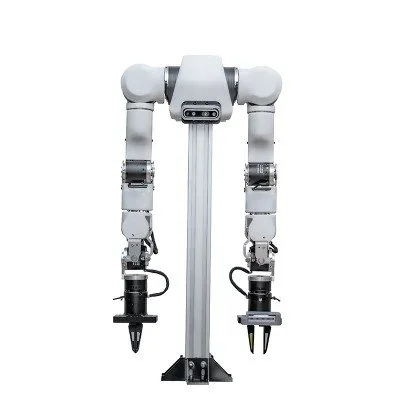
The operator holds a second, lighter arm with the same joint layout as the robot and moves it through the task; the robot follows joint by joint. Because the mapping is one-to-one, there is no inverse kinematics to tune and little operator training. ALOHA showed that a low-cost bimanual leader-follower rig plus the ACT policy learns six difficult real-world tasks at 80–90% success from about 10 minutes of demonstrations1. ALOHA 2 improved performance, ergonomics and robustness and open-sourced the full hardware design together with a MuJoCo model7. GELLO generalized the idea to existing industrial arms with 3D-printed, kinematically matched controllers built from off-the-shelf motors; in its user study, operators collected demonstrations more reliably and efficiently than with VR controllers or a 3D SpaceMouse2. Hugging Face's SO-101 brought the pattern to the hobby price point, with a leader arm geared so it can be moved without much force9.
What we list: RC Aloha Leader$2,500.00 and RC OpenArm V1 Leader$6,500.00 (our products), i2RT YAM Leader$2,999.00 and i2RT BIG YAM Leader$3,449.00, Seeed Studio Star Arm 102 Leader ArmRequest a Quote, complete systems such as Trossen Robotics ALOHA Stationary$27,999.00 and Trossen Robotics ALOHA Mobile$36,999.00, and RC Mobile Aloha$20,000.00 (our product). For a direct comparison of the two most common open arms, see OpenArm vs SO-100.
VR / XR teleoperation
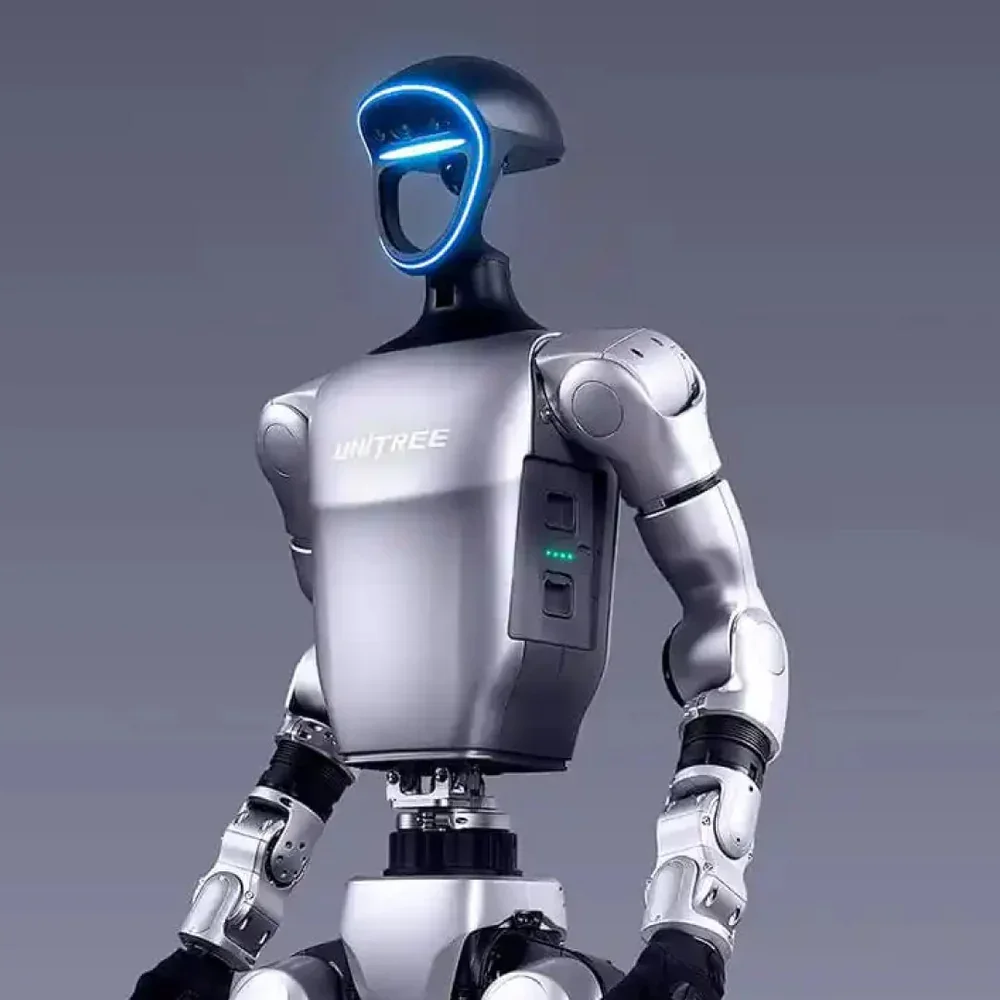
A headset tracks the operator's head and hands, a retargeting layer maps them onto the robot, and the robot's stereo cameras stream back to the headset. Open-TeleVision showed that this kind of immersive, stereoscopic active vision lets an operator collect demonstrations for long-horizon tasks on two different humanoids10. Unitree publishes xr_teleoperate, an open-source stack that drives its G1, H1, H2 and R1 humanoids from Apple Vision Pro, PICO 4 Ultra Enterprise or Meta Quest 3, with built-in data recording for imitation learning3.
What we list: Unitree VR Remote Operation Kit (PICO VR Kit)$2,400.00, Unitree G1 Teleop Kit (no robot)$15,000.00, Meta Quest 3S$450.00 and TianJi Marvin6-Apex VR Teleoperation SystemRequest a Quote. Our VR teleoperation companies comparison and the VR teleoperation hardware guide go deeper on headsets and software.
Data gloves and dexterous hands
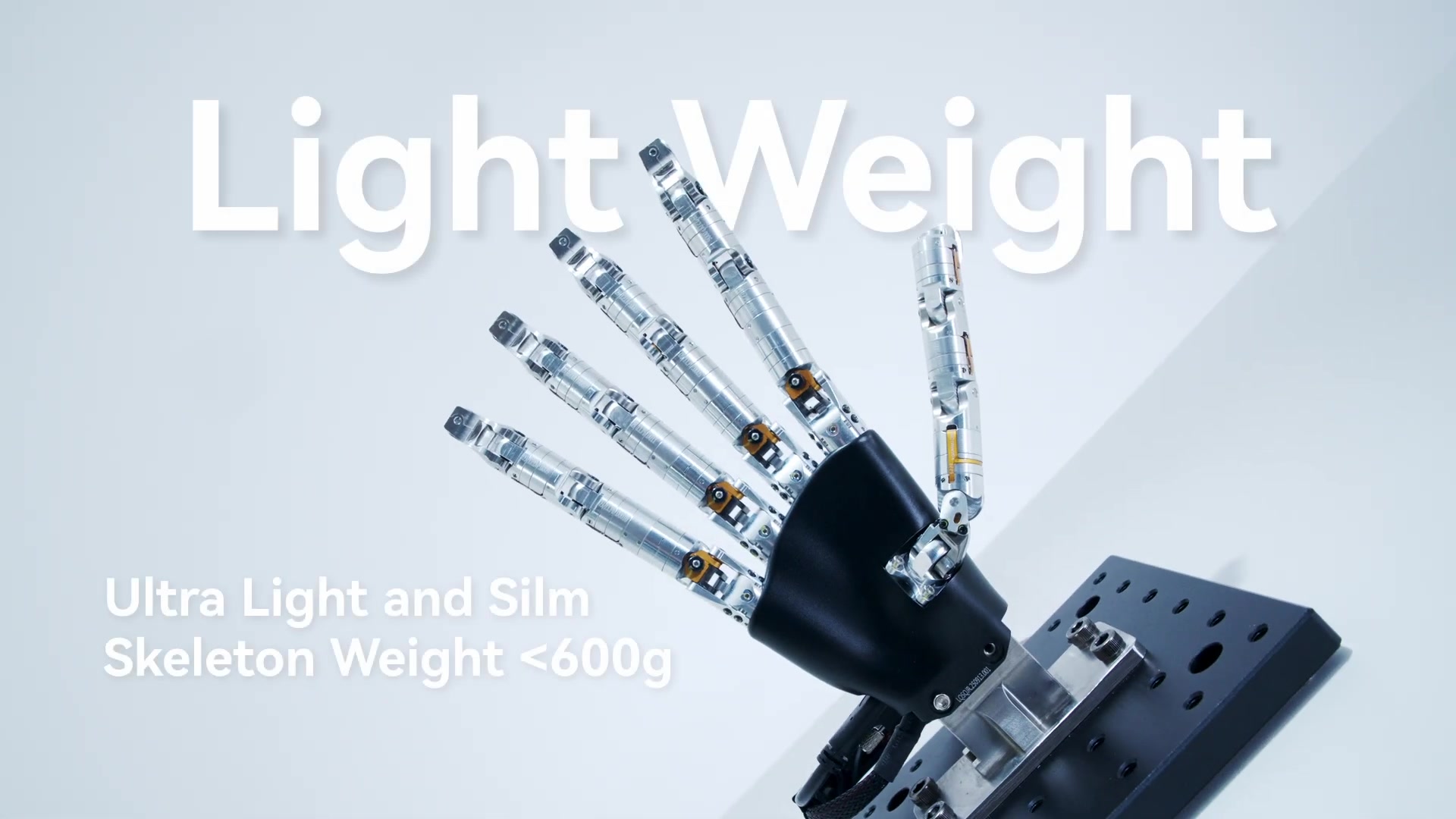
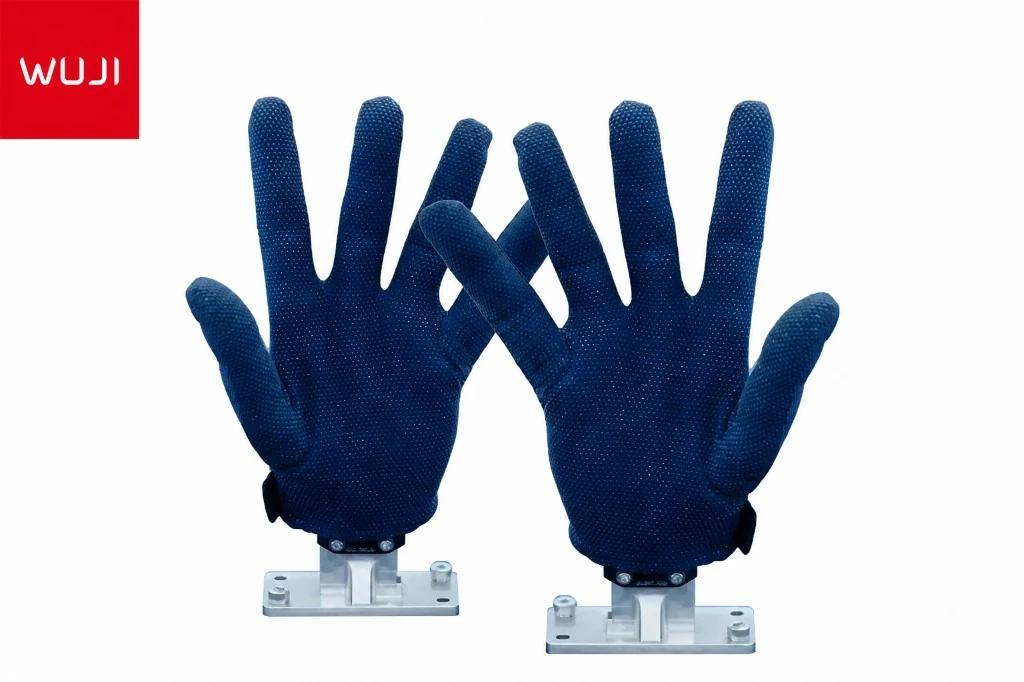
Arms and headsets stop at the wrist; gloves cover the fingers. Commercial gloves use different sensing: the Manus Metagloves Pro, for example, uses electromagnetic-field tracking and a 25-degree-of-freedom hand model11, while the Wuji Glove records tactile pressure alongside fingertip posture and motion12. On the research side, DexCap combined SLAM with electromagnetic sensing for occlusion-resistant wrist and finger tracking, and learned dexterous skills from portable mocap data13. Vision-only hand tracking, as in AnyTeleop, trades some precision for needing nothing more than cameras16.
What we list: Wuji Glove$4,500.00, RC G1 Tactile Glove$3,625.00 (our product), Manus Metagloves ProRequest a Quote, UDEXREAL UDCAP DATA GLOVE$3,500.00 and LinkerBot GlovesRequest a Quote. Compare them side by side in the data glove comparison tool, pair them with a hand from the dexterous hand comparison tool, and see our Wuji Hand teleoperation guide.
Exoskeletons and motion capture
A worn exoskeleton gives joint-level control of the whole arm, including the elbow, which a wrist-only interface cannot set. AirExo, a low-cost dual-arm exoskeleton, reported that about 3 minutes of teleoperated demonstrations plus in-the-wild exoskeleton data matched or beat a policy trained on more than 20 minutes of teleoperation4. HOMIE paired an isomorphic exoskeleton arm with Hall-sensor gloves and a pedal for humanoid loco-manipulation, reported finishing tasks in half the time of earlier teleop systems, and lists a hardware cost of $5005. At the far end, HumanPlus had a humanoid shadow a person's body and hands from a single RGB camera and reached 60–100% task success with up to 40 demonstrations14.
What we list: DM Robot Daimon DM-EXton2$8,000.00, LinkerBot Half-Body MoCapRequest a Quote, LinkerBot Control$4,000.00, Noitom PN 3 Motion Capture - Full Body$1,599.00 and optical motion-capture cameras such as CHINGMU MC4000 Camera$7,300.00.
Remote and internet teleoperation
Remote teleop moves the operator out of the room. RoboTurk showed this at scale years before the current wave: operators used ordinary phones over the internet, poor network conditions did not substantially affect their ability to finish demonstrations, and the pilot gathered 137.5 hours of manipulation data with over 2,200 successful demonstrations in 22 hours of system use15. Remote teleop is a software and operations choice rather than a hardware category, so we have no catalog statistics for it; our article on handling latency and packet loss over the internet and the teleoperation platform page cover the practical side.
Our data
Two sources, both read-only, both summarized below. The method is described in How we built this report.
What we list: teleoperation hardware in our catalog
Snapshot of our store catalog on November 11, 2026: products a shopper sees in the main store, after the store's own pricing rules (quote-only brands, rentals and unverified prices show "Request a quote"). A model is one product page; variants of the same product count once. Prices are each model's lowest listed variant price on that date; live prices are on each product card.
| Type | Models | With public price | Quote only | In stock | Median price (from) |
|---|---|---|---|---|---|
| Leader-follower arms and systems | 11 | 8 | 3 | 7 | ≈ $7,200 |
| VR / XR teleoperation kits | 5 | 4 | 1 | 0 | ≈ $8,700 |
| Data gloves | 8 | 4 | 4 | 5 | ≈ $3,600 |
| Exoskeleton and motion capture | 8 | 6 | 2 | 0 | ≈ $5,700 |
| All teleoperation interfaces | 32 | 22 (69%) | 10 | 12 (38%) |
Models listed, by type (Nov 11, 2026)
What the table shows:
- Leader-follower arms are the most available type. Seven of 11 models were in stock on the snapshot date, and they cover everything from a single leader arm to a complete mobile bimanual system.
- Gloves have the lowest median. The priced gloves have the lowest median of the four types, and half of the glove models are sold by quote.
- VR kits split in two. The type mixes consumer headsets with humanoid teleop kits that bundle software, headset and integration, which is why the median sits high.
- Where the makers are. By each maker's headquarters (our classification), 17 of the 32 models come from makers in mainland China, 8 from the United States (including our own products), 3 from the Netherlands, and 4 from one maker whose headquarters we have not confirmed.
Four of the 32 models are our own products: RC Aloha Leader$2,500.00, RC OpenArm V1 Leader$6,500.00, RC Mobile Aloha$20,000.00 and the RC G1 Tactile Glove$3,625.00. We count them like any other listing.
What buyers ask about: teleoperation inquiries
We grouped the buyer inquiries that reached us through the website's quote, contact and chat forms between September 21 and November 11, 2026 (381 inquiries; only buyer inquiries were counted, so internal and test entries and non-buyer submissions such as careers, support and event forms were left out). Each inquiry was classified by keywords in the product it named and the text of the request; one inquiry can name several types. Only groups of five or more inquiries are reported, and nothing here identifies a buyer.
Teleoperation inquiries by type named (Sep 21 – Nov 11, 2026; 71 inquiries)
| Measure (Sep 21 – Nov 11, 2026) | Inquiries | Share |
|---|---|---|
| Buyer inquiries in the window | 381 | 100% |
| Mention teleoperation or a teleoperation interface | 71 | 19% |
| …of which were formal quote requests | 34 | 48% of 71 |
| Ask about a data collection service | 52 | 14% |
| …of which also mention teleoperation | 16 | 31% of 52 |
What the inquiries show:
- Leader-follower platforms lead buyer interest, named in 38 of the 71 teleoperation inquiries, ahead of gloves (14) and VR/XR (5). Exoskeleton and motion-capture requests were too few to report on their own.
- Many buyers start from the task, not the device. 28 inquiries asked about teleoperation without naming any interface, which is where the how to choose section below is aimed.
- Data collection is a parallel demand. About one inquiry in seven asked for collected data rather than (or as well as) hardware, and a third of those also mentioned teleoperation.
These are counts of inquiries in a seven-week window, not a survey of the market. We will repeat the same method for the 2027 edition so the numbers can be compared year on year.
What we see firsthand
We run teleoperated data collection for customers and sell the rigs we use. Our teleoperation data collection service picks the interface per task: leader-follower arms (ALOHA-style arms and OpenArm) for precise bimanual work, Meta Quest 3 headsets for large workspaces and mobile manipulation, SpaceMouse for simple Cartesian tasks, and haptic gloves for dexterous hands. Every sensor joins a shared clock before production, each delivery includes a timing report against stated targets, and datasets ship as HDF5, RLDS or LeRobot. Glove-driven collection for dexterous hands is covered on the dexterous hand data page, which is where the clip below comes from: VR tracks the operator's arm while a glove controls the fingers, producing synchronized arm-and-hand teleoperation data.
Arm + hand teleoperation with glove and VR, from our dexterous hand data collection page.
Technology trends
1. Data scaling: diversity beats volume
Open robot datasets have grown large: Open X-Embodiment pooled data from 22 robots across 21 institutions covering 527 skills17, and DROID collected 76,000 demonstration trajectories (350 hours) in 564 scenes with 50 data collectors over 12 months18. Generalist policies such as π₀ train on data from single-arm, dual-arm and mobile manipulators and are evaluated on dexterous tasks like laundry folding19. The most useful finding for anyone planning a collection campaign comes from a 2024 scaling study that collected over 40,000 demonstrations: policy generalization follows a roughly power-law relationship with the number of environments and objects, the diversity of environments and objects matters far more than the absolute number of demonstrations, and returns flatten once each environment has enough demonstrations6. For teleoperation that means operator time is best spent on more scenes and objects, not on more repetitions of one scene. Our teleoperation data quality checklist turns this into a collection plan.
2. Latency: from the operator's link to the policy's inference
Latency shows up twice. During collection, network delay affects the operator; RoboTurk found that poor network conditions did not substantially affect remote operators' ability to finish demonstrations15. During deployment, the trained policy has its own delay: UMI added inference-time latency matching so policies trained on handheld data still work on the robot20, ACT predicts chunks of future actions rather than one step at a time1, and real-time chunking (2025) generates the next chunk while the current one executes, which its authors report makes diffusion- and flow-based VLA policies robust to inference delay without retraining21. Practical guidance is in our internet delay handling article.
3. Bimanual and mobile teleoperation
More teleoperation setups are bimanual, and more of them are mobile. Mobile ALOHA put a bimanual leader-follower rig on a mobile base for whole-body teleoperation, trained with 50 demonstrations per task, and reported that co-training with existing static ALOHA data raised success rates by up to 90%8. Humanoids extend the same idea to the whole body through XR stacks103, exoskeleton cockpits5 and camera-based shadowing14. See our bimanual teleoperation hardware setup guide and the bimanual manipulation survey.
4. Robot-free collection sits next to teleoperation
Handheld grippers like UMI collect demonstrations without a robot in the loop and produce policies that their authors describe as hardware-agnostic20; exoskeletons such as AirExo blend in-the-wild human data with a small amount of teleoperation4. These methods complement teleoperation rather than replace it: teleop still records the robot's own embodiment and contact, and many teams mix both. Our ALOHA vs UMI comparison walks through when each fits.
5. Operator ergonomics is now a data-quality topic
Long collection shifts make operator comfort part of data quality. ALOHA 2 explicitly lists ergonomics among its improvements7, and GELLO's user study measured reliability and efficiency of demonstration collection across interfaces2. Our teleoperation fatigue and ergonomics study covers shift length, posture and rotation.
How to choose a teleoperation setup
Start from the task and the robot, then pick the interface:
- If you need precise tabletop or bimanual manipulation on arms, choose a leader-follower pair matched to your follower arm. Compare arms in the robot arm comparison tool and read OpenArm vs SO-100.
- If you are driving a humanoid or working across a large or mobile workspace, choose a VR/XR stack supported by the robot maker, and check the humanoid comparison tool.
- If finger-level control matters (in-hand manipulation, tool use), choose a data glove paired with a dexterous hand: use the data glove tool, the dexterous hand tool and Wuji Hand vs Shadow Hand.
- If you need whole-arm posture or whole-body motion, consider an exoskeleton or motion capture setup.
- If you mostly need data, not a rig, compare collection methods in ALOHA vs UMI or ask us about our teleoperation data collection service.
Buying guides: the teleoperation solution buyer's guide, the cost of building a teleoperation rig, how to set up a teleoperation lab, glove-based dexterous teleoperation, camera setup for teleoperation and SpaceMouse teleoperation. All category tools are on the comparison hub; if you would rather try before buying, most rigs are also available to lease.
The teleoperation library
Everything we have published on teleoperation, in one place.
Getting started
- Getting started with robot teleoperation
- Teleoperation guide
- Teleoperation systems overview
- Set up an ALOHA teleop rig
- ALOHA robot guide, Mobile ALOHA setup and Mobile ALOHA cost
Choosing hardware
- Robot teleoperation methods compared
- VR teleoperation companies compared
- VR teleoperation hardware guide
- ALOHA vs UMI data collection
- Wuji Hand teleoperation guide
Running collection
- Teleoperation data quality checklist
- Teleoperation fatigue and ergonomics study
- Robot teleoperation over the internet: latency and packet loss
- OpenArm teleop data logging guide
- Teleoperation workforce strategy
Data and models
- Why teleoperation data beats simulation data
- Teleoperation data vs kinesthetic teaching
- Teleoperation datasets
- Models for teleoperation bootstrapping
- Teleoperation data collection service
How we built this report
- Catalog statistics come from a read-only snapshot of our store's product table taken on November 11, 2026. We counted products visible in the main store, applied the same pricing rules the store applies at checkout, and assigned each product to a type by an explicit product list (not by store category). Haptic master devices listed only on brand pages are not counted.
- Inquiry statistics are counts over buyer inquiries received through the website between September 21 and November 11, 2026, classified by keywords. Only buyer inquiries were counted; internal and test entries and non-buyer submissions (careers, support, events and similar) were left out. Groups smaller than five inquiries are not reported. No names, companies, contact details or deal values were read into the report.
- Third-party claims are cited to the paper or the maker's own page below. Nothing in "Our data" is a lab measurement; it describes what we list and what we were asked.
Disclosure: Robotics Center sells many of the products named on this page, and the products marked "our product" are made or assembled for us under the Robotics Center name.
Sources
- Zhao, Kumar, Levine, Finn. "Learning Fine-Grained Bimanual Manipulation with Low-Cost Hardware" (ALOHA / ACT), arXiv:2304.13705, 2023. https://arxiv.org/abs/2304.13705 (accessed 2026-11). ↩
- Wu et al. "GELLO: A General, Low-Cost, and Intuitive Teleoperation Framework for Robot Manipulators", arXiv:2309.13037, 2023. https://arxiv.org/abs/2309.13037 (accessed 2026-11). ↩
- Unitree Robotics. "xr_teleoperate" (GitHub repository). https://github.com/unitreerobotics/xr_teleoperate (accessed 2026-11). ↩
- Fang et al. "AirExo: Low-Cost Exoskeletons for Learning Whole-Arm Manipulation in the Wild", arXiv:2309.14975, 2023. https://arxiv.org/abs/2309.14975 (accessed 2026-11). ↩
- Ben et al. "HOMIE: Humanoid Loco-Manipulation with Isomorphic Exoskeleton Cockpit", arXiv:2502.13013, 2025. https://arxiv.org/abs/2502.13013 (accessed 2026-11). ↩
- Lin et al. "Data Scaling Laws in Imitation Learning for Robotic Manipulation", arXiv:2410.18647, 2024. https://arxiv.org/abs/2410.18647 (accessed 2026-11). ↩
- ALOHA 2 Team. "ALOHA 2: An Enhanced Low-Cost Hardware for Bimanual Teleoperation", arXiv:2405.02292, 2024. https://arxiv.org/abs/2405.02292 (accessed 2026-11). ↩
- Fu, Zhao, Finn. "Mobile ALOHA: Learning Bimanual Mobile Manipulation with Low-Cost Whole-Body Teleoperation", arXiv:2401.02117, 2024. https://arxiv.org/abs/2401.02117 (accessed 2026-11). ↩
- Hugging Face. "SO-101", LeRobot documentation. https://huggingface.co/docs/lerobot/so101 (accessed 2026-11). ↩
- Cheng, Li, Yang, Yang, Wang. "Open-TeleVision: Teleoperation with Immersive Active Visual Feedback", arXiv:2407.01512, 2024. https://arxiv.org/abs/2407.01512 (accessed 2026-11). ↩
- MANUS. "Metagloves Pro" product page. https://www.manus-meta.com/products/metagloves-pro (accessed 2026-11). ↩
- Wuji. Wuji documentation (Wuji Glove). https://docs.wuji.tech/ (accessed 2026-11). ↩
- Wang et al. "DexCap: Scalable and Portable Mocap Data Collection System for Dexterous Manipulation", arXiv:2403.07788, 2024. https://arxiv.org/abs/2403.07788 (accessed 2026-11). ↩
- Fu, Zhao, Wu, Wetzstein, Finn. "HumanPlus: Humanoid Shadowing and Imitation from Humans", arXiv:2406.10454, 2024. https://arxiv.org/abs/2406.10454 (accessed 2026-11). ↩
- Mandlekar et al. "RoboTurk: A Crowdsourcing Platform for Robotic Skill Learning through Imitation", arXiv:1811.02790, CoRL 2018. https://arxiv.org/abs/1811.02790 (accessed 2026-11). ↩
- Qin et al. "AnyTeleop: A General Vision-Based Dexterous Robot Arm-Hand Teleoperation System", arXiv:2307.04577, 2023. https://arxiv.org/abs/2307.04577 (accessed 2026-11). ↩
- Open X-Embodiment Collaboration. "Open X-Embodiment: Robotic Learning Datasets and RT-X Models", arXiv:2310.08864, 2023. https://arxiv.org/abs/2310.08864 (accessed 2026-11). ↩
- Khazatsky et al. "DROID: A Large-Scale In-The-Wild Robot Manipulation Dataset", arXiv:2403.12945, 2024. https://arxiv.org/abs/2403.12945 (accessed 2026-11). ↩
- Black et al. "π₀: A Vision-Language-Action Flow Model for General Robot Control", arXiv:2410.24164, 2024. https://arxiv.org/abs/2410.24164 (accessed 2026-11). ↩
- Chi, Xu et al. "Universal Manipulation Interface: In-The-Wild Robot Teaching Without In-The-Wild Robots", arXiv:2402.10329, 2024. https://arxiv.org/abs/2402.10329 (accessed 2026-11). ↩
- Black, Galliker, Levine. "Real-Time Execution of Action Chunking Flow Policies", arXiv:2506.07339, 2025. https://arxiv.org/abs/2506.07339 (accessed 2026-11). ↩
Free download
Get State of Robot Teleoperation 2026 as a PDF
The full report in one file, with the catalog and inquiry data tables and every source, to read offline or share with your team. Leave your name and work email and the download starts right away.