

State of Egocentric Data Collection Devices 2026
Head-mounted egocentric rigs, handheld UMI-style grippers and multimodal capture kits in 2026: a market map by type, catalog and buyer-interest data from the Robotics Center store, the research behind the trend, and how to choose.
Key takeaways
Robot-free data capture has become a product category of its own. Teams that used to need a robot to record each demonstration can now record people doing the task, either with a head-mounted camera rig or with a handheld gripper that copies a robot's end effector. The research case is now well documented: the original Universal Manipulation Interface (UMI) showed handheld-gripper demonstrations can train policies that run on different robots1, EgoMimic reported that an extra hour of human hand data was worth more than an extra hour of robot data in its setup2, and data-scaling work found that the variety of environments and objects matters far more than the raw number of demonstrations3. In the Robotics Center store, 14 egocentric and UMI-style capture devices from 8 brands are listed as of November 2026; most are sold on quote, and the hardware splits about two to one between head-worn rigs and handheld grippers. Egocentric and UMI capture came up in about one in fifteen buyer inquiries we received between late September and mid-November 2026 (details and method below).
Market map by type
Four device types cover almost everything on the market today. The tables list each device by what it captures; specifications come from each maker's own pages unless noted. Devices are listed alphabetically by brand within each type, which is not a ranking. Products marked "our product" are built and sold by Robotics Center.
Head-mounted egocentric rigs
A camera rig worn on the head records what the person sees, usually with an IMU for head motion and often with wide or stitched fields of view so both hands stay in frame. These rigs suit teams collecting large volumes of human task video, for example household or factory work, where the goal is hand and object motion rather than a robot's exact gripper state. The table covers the GenRobot DAS EgoRequest a Quote, GI Labs EGO1GSRequest a Quote, Maniformer MEgo ViewRequest a Quote and Orbbec EGORequest a Quote.
| Device | Cameras | Field of view | Video | Motion sensing |
|---|---|---|---|---|
| GenRobot DAS Ego | 6 RGB cameras4 | Over 270° horizontal, 150° vertical4 | 1600 × 1300 at 30 Hz4 | 6-axis IMU at 200 Hz; 350 g4 |
| GI Labs EGO1GS | Stereo pair, global shutter, 63 mm baseline5 | 157° × 84° per camera5 | 1080p at 30 fps5 | 9-DoF IMU at 400 Hz5 |
| Maniformer MEgo View | 3 fisheye + 1 stereo head camera, plus 2 wrist cameras6 | Panoramic head view6 | 2 MP at 60 fps, global shutter6 | Automotive-grade 9-axis IMU at 1000 Hz6 |
| Orbbec EGO | Stereo, four-fisheye or fisheye-plus-depth models7 | Up to H 165° / V 130° per camera; about 280° stitched on the four-camera model7 | Up to 1920 × 1200 at 30 fps; 1600 × 1200 at 60 fps on the four-camera model7 | 6- or 9-axis IMU, image-IMU sync within 1 ms7 |
Also listed in this group in our store: AgileX PiKA Ego-HRequest a Quote, Lumos Ego LiteRequest a Quote and the backpack-mounted Lumos FastUMI GoRequest a Quote (Lumos describes its FastUMI Pro as a backpack-mounted universal manipulation interface device8), and our own RC E1 Egocentric SystemRequest a Quote (our product: a modular first-person capture rig, specified per project on quote) and RC E1 Ego Camera SetRequest a Quote (our product: an egocentric camera kit, configured and sold on quote).
Handheld UMI-style grippers
A handheld gripper with a wrist camera records exactly what a robot gripper would see and do, so the data maps directly onto a parallel-jaw robot. UMI introduced the pattern1; FastUMI later redesigned it around decoupled hardware and an off-the-shelf tracker to make it cheaper to deploy, and released more than 10,000 demonstrations across 22 tasks9. These devices suit teams that train policies for a specific gripper and want precise end-effector trajectories. The table covers the AgileX PiKA Data Gripper KitFrom $5,949.96, Maniformer MEgo GripperRequest a Quote, Orbbec UMIRequest a Quote and our own RC Dex-UMI$9,800.00.
| Device | Wrist vision | Tracking | Gripper or hand |
|---|---|---|---|
| AgileX PiKA Data Gripper Kit | RGB and depth up to 1280 × 720 at 90 fps10 | Up to ±1.5 mm, pose output up to 120 Hz, using the PiKA Station base10 | Two-finger gripper, 2 kg maximum force; pairs the handheld PiKA Sense with the PiKA Station10 |
| Maniformer MEgo Gripper | Triple-camera RGB with 200° fisheye view, 2 MP at 60 fps, global shutter6 | 9-axis IMU at 1000 Hz6 | Two-finger; quick-change 3D tactile fingers optional6 |
| Orbbec UMI | 2 MP fisheye RGB plus 1.2 MP global-shutter SLAM camera, 30 or 60 fps7 | Image-IMU sync under 1 ms7 | Handheld module for fine manipulation7 |
| RC Dex-UMI (our product) | Wrist cameras | Policy-learning pipeline support | Multi-finger, LEAP-hand-compatible end effector (for the research behind dexterous UMI capture, see DexUMI11) |
Multimodal and tactile kits
Kits in this group combine an egocentric view with wrist, gripper and sometimes tactile or motion-capture inputs on one clock. They suit teams that want several views of the same demonstration, or contact information that a camera cannot see. SenseXperience$2,799.00 combines an egocentric unit, wrist unit, gripper unit and compute unit, with motion-capture and tactile gloves as options, and exports LeRobot, HDF5 and MCAP12. The Maniformer MEgo Gripper's optional tactile fingers also fit here.
Reference research devices
Meta's Project Aria glasses are a research device built for egocentric, multimodal recording and widely used in egocentric research13. Aria Gen 2 carries four SLAM cameras, an RGB camera, two eye-tracking cameras, an IMU, microphones, GNSS and PPG sensors, and is available to researchers who apply for the Aria Research Kit14. We do not sell Aria; it is listed here as the reference point many egocentric studies use.
Our data
Catalog snapshot (November 2026)
These numbers come from the Robotics Center store catalog on 2026-11-11. They cover the 14 non-hidden products in the egocentric device class, the same list as the egocentric comparison tool. Prices change; the table below shows each live price, not a copy.
| Measure | Count |
|---|---|
| Models listed | 14 (18 configurations) |
| Brands | 8 |
| Head-mounted rigs / handheld grippers and kits | 9 / 5 |
| Models with a public price | 3 (all handheld) |
| Models sold on quote | 11 |
| Models listed as in stock | 12 |
| Models that can be bought online today (public price and in stock) | 3 |
| Models that are our own products | 3 |
For comparison, about 71% of all 1,079 catalog products show a public price, against 3 of 14 here: egocentric capture hardware is still mostly configured and quoted per project. The three with a public price today:
| Device | Type | Live price |
|---|---|---|
| AgileX PiKA Data Gripper Kit | Handheld | From $5,949.96 |
| RC Dex-UMI (our product) | Handheld, multi-finger | $9,800.00 |
| SenseXperience | Multimodal kit | $2,799.00 |
Brands by headquarters, as stated by each maker or a business registry:
| Headquarters | Brands | Models in our catalog |
|---|---|---|
| United States | GI Labs (San Francisco)5, Robotics Center (San Francisco) | 4 |
| China | AgileX Robotics (Dongguan)10, GenRobot AI (Beijing)15, Maniformer (Shanghai)6 | 5 |
| China and United States offices | Orbbec (Shenzhen; Troy, Michigan)16 | 2 |
| Not stated on the maker pages we checked | IO-AI Tech, Lumos | 3 |
Buyer interest (inquiries, 21 Sep to 11 Nov 2026)
We counted inquiries submitted through roboticscenter.ai forms, quote requests and the chat handoff between 2026-09-21 and 2026-11-11 (461 in total; our inquiry records start on 2026-09-21). An inquiry counts as egocentric-related when it was sent from an egocentric or UMI device page, or when its text mentions egocentric, first-person or head-mounted capture, UMI, human demonstration video, or one of these devices by name. Only buyer inquiries are counted; careers messages and other non-buyer submissions are excluded. Counts are form submissions, not unique organisations, and the classification is keyword-based. Only groups of five or more are shown.
| Group | Inquiries |
|---|---|
| All egocentric-related | 31 (7% of all inquiries) |
| Quote or purchase requests for egocentric or UMI-style capture devices | 22 (18 of them in October; 13 name a head-mounted rig) |
| Requests for managed data collection using egocentric or UMI capture | 5 |
Most of these inquiries were about buying capture devices, and 13 of the 22 device requests named a head-mounted rig, so head-worn capture drew more purchase interest than handheld grippers in this window. The window is seven weeks, so treat these as a snapshot rather than a trend line; we will repeat the count with a full year of data in the 2027 edition.
What we run ourselves
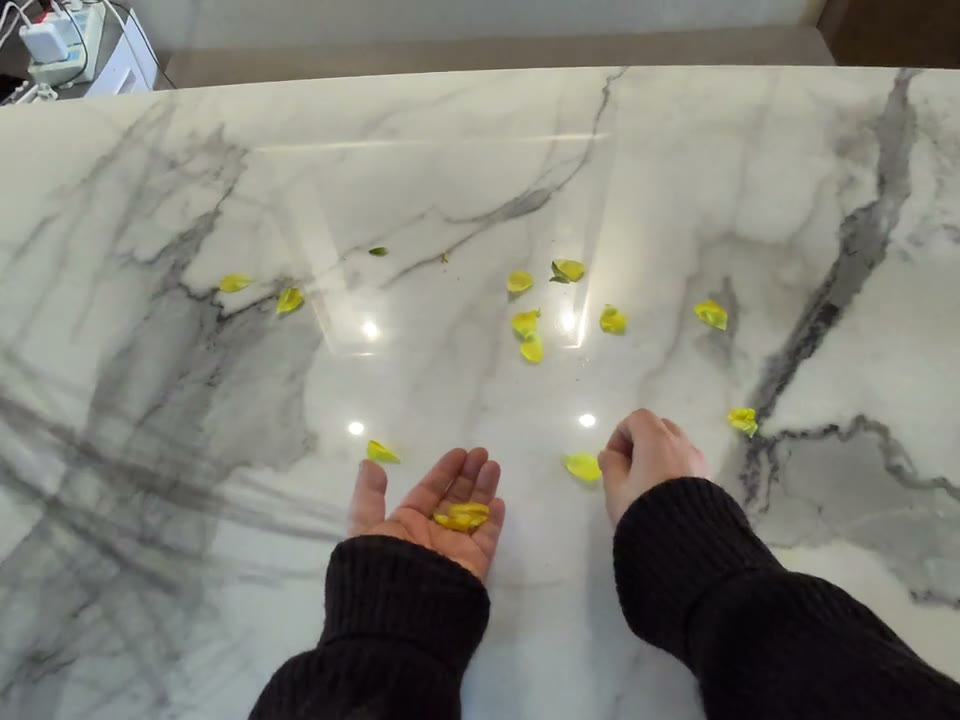
We collect egocentric demonstration data for customers with two setups: a head camera with a tactile glove (egocentric video, hand pose, tactile signals and task labels) and a head camera on its own (egocentric video, timestamps, session metadata and task labels). Our dexterous hand data page shows eleven egocentric sample clips from our collection runs, covering food preparation, object organisation and garment handling. Datasets are delivered as HDF5, RLDS/TFRecord, LeRobot/Parquet or an agreed custom schema; see Robot Data Formats Compared for the trade-offs.
Technology trends
Human video as robot training data. Large egocentric video datasets came first from computer vision: Ego4D recorded 3,670 hours of daily-life video from 931 camera wearers in 9 countries17, and Ego-Exo4D added 1,286 hours of skilled activity filmed from first- and third-person views together18. Robotics work now trains policies on this kind of footage directly. EgoMimic treats human and robot demonstrations as one training stream2, and the HAT model treats humans and humanoids as two embodiments in one action space, trained on the egocentric PH2D dataset19.
Hands, not only grippers. EgoDex recorded 829 hours of egocentric video across 194 tabletop tasks with Apple Vision Pro, pairing each frame with 3D hand and finger tracking20. DexCap built a portable hand motion-capture system for dexterous imitation learning21, and DexUMI used the human hand itself as the interface through a wearable exoskeleton, reporting an 86% average task success rate on two dexterous robot hands11. Expect more capture devices that record finger joints and contact, not only wrist pose.
Handheld grippers keep getting cheaper to deploy. After UMI1, FastUMI showed the same idea with simpler, hardware-independent components9, and commercial kits ship with tracking and cameras built in: the PiKA adds depth sensing10 and the MEgo Gripper a 200° fisheye view6.
Diversity beats volume. The data-scaling study by Lin et al. found that "the diversity of environments and objects is far more important than the absolute number of demonstrations"3. This is the main argument for portable, robot-free capture: it is the cheapest way to record many scenes. Device makers are planning for that scale; Lumos, for example, has said it plans to deploy 10,000 FastUMI units in 20268.
Research devices set the sensor bar. Project Aria's sensor set (multiple SLAM cameras, eye tracking, IMU, audio) defined what a research-grade egocentric recorder carries1314, and commercial rigs now compete on global shutters, synchronised IMUs and wider fields of view, as the tables above show.
How to choose
- Choose a head-mounted rig if you need many hours of natural human task video, both hands in view, and you will retarget or learn from hand motion. Compare field of view, shutter type and frame rate side by side in the egocentric comparison tool.
- Choose a handheld UMI-style gripper if your robot uses a parallel-jaw gripper and you want trajectories that transfer directly. Read ALOHA vs UMI and the AgileX PiKA data collection guide.
- Choose a multimodal or tactile kit if contact matters for your task (insertion, deformables, in-hand manipulation), or if you want egocentric and wrist views of the same demonstration.
- Check the data format first. If you train with LeRobot, confirm the device exports LeRobot or a format you can convert; see Robot Data Formats Compared.
- Buy or outsource. If you would rather receive a finished dataset than run a collection team, our data collection services and dexterous hand data pages describe both egocentric setups.
For device-by-device detail, see the head-to-head Egocentric Data Collection Devices 2026 comparison, browse data collection hardware in the store, or read how robots learn from video.
Sources
- Chi et al., "Universal Manipulation Interface: In-The-Wild Robot Teaching Without In-The-Wild Robots," arXiv:2402.10329, 2024. https://arxiv.org/abs/2402.10329 (accessed 2026-11) ↩
- Kareer et al., "EgoMimic: Scaling Imitation Learning via Egocentric Video," arXiv:2410.24221, 2024. https://arxiv.org/abs/2410.24221 (accessed 2026-11) ↩
- Lin et al., "Data Scaling Laws in Imitation Learning for Robotic Manipulation," arXiv:2410.18647, 2024. https://arxiv.org/abs/2410.18647 (accessed 2026-11) ↩
- GenRobot, "DAS Ego" product page. https://www.genrobot.ai/products/ego (accessed 2026-11) ↩
- General Intelligence Labs, "EGO1GS" product page. https://gilabs.xyz/products/ego1gs (accessed 2026-11) ↩
- Maniformer, "MEgo" product page (MEgo View and MEgo Gripper). https://www.maniformer.ai/en/mego (accessed 2026-11) ↩
- Orbbec, "Robot-free data collection hardware platform" (EGO series and UMI F-3). https://www.orbbec.com.cn/xin/products/robot-free-data-collection/ (accessed 2026-11) ↩
- KrASIA, "This company has built a backpack-style system for robotics data collection," 17 February 2026. https://kr-asia.com/this-company-has-built-a-backpack-style-system-for-robotics-data-collection (accessed 2026-11) ↩
- Zhaxizhuoma et al., "FastUMI: A Scalable and Hardware-Independent Universal Manipulation Interface with Dataset," arXiv:2409.19499, 2024. https://arxiv.org/abs/2409.19499 (accessed 2026-11) ↩
- AgileX Robotics, "Pika Pro: Embodied AI Data Collection" product page (specifications and company address). https://global.agilex.ai/products/pika-pro-embodied-ai-data-collection (accessed 2026-11) ↩
- Xu et al., "DexUMI: Using Human Hand as the Universal Manipulation Interface for Dexterous Manipulation," arXiv:2505.21864, 2025. https://arxiv.org/abs/2505.21864 (accessed 2026-11) ↩
- IO-AI Tech, "SenseXperience" product page. https://io-ai.tech/en/sensexperience/ (accessed 2026-11) ↩
- Engel et al., "Project Aria: A New Tool for Egocentric Multi-Modal AI Research," arXiv:2308.13561, 2023. https://arxiv.org/abs/2308.13561 (accessed 2026-11) ↩
- Meta, "Project Aria glasses" (Aria Gen 2 and the Aria Research Kit). https://www.projectaria.com/glasses/ (accessed 2026-11) ↩
- Dealroom, "GenRobot AI" company profile. https://dealroom.co/companies/genrobot-ai/ (accessed 2026-11) ↩
- Orbbec, company website (office addresses). https://www.orbbec.com/ (accessed 2026-11) ↩
- Grauman et al., "Ego4D: Around the World in 3,000 Hours of Egocentric Video," arXiv:2110.07058, 2021. https://arxiv.org/abs/2110.07058 (accessed 2026-11) ↩
- Grauman et al., "Ego-Exo4D: Understanding Skilled Human Activity from First- and Third-Person Perspectives," arXiv:2311.18259, 2023. https://arxiv.org/abs/2311.18259 (accessed 2026-11) ↩
- Qiu et al., "Humanoid Policy ~ Human Policy," arXiv:2503.13441, 2025. https://arxiv.org/abs/2503.13441 (accessed 2026-11) ↩
- Hoque et al., "EgoDex: Learning Dexterous Manipulation from Large-Scale Egocentric Video," arXiv:2505.11709, 2025. https://arxiv.org/abs/2505.11709 (accessed 2026-11) ↩
- Wang et al., "DexCap: Scalable and Portable Mocap Data Collection System for Dexterous Manipulation," arXiv:2403.07788, 2024. https://arxiv.org/abs/2403.07788 (accessed 2026-11) ↩
Free download
Get State of Egocentric Data Collection Devices 2026 as a PDF
The full report in one file, with the catalog and inquiry data tables and every source, to read offline or share with your team. Leave your name and work email and the download starts right away.