

Best Data Gloves for Robot Teleoperation in 2026
Data and teleoperation gloves for robot learning in 2026: Wuji Glove, MANUS Metagloves Pro, UDEXREAL UDCAP, LinkerBot gloves and our RC G1 Tactile Glove, compared on sensing, rate and integration.
A data glove turns the motion of a human hand into numbers a robot can use. In a teleoperation setup the glove drives a dexterous robot hand in real time; in a data campaign the same stream is recorded next to camera video so a policy can learn from it. The gloves below all do that job, but they measure different things: some track where each fingertip is in space, some measure joint angles, and some measure contact pressure across the palm. Picking the right one starts with knowing which of those signals your project needs.
This guide covers the data and teleoperation gloves sold in our store as of November 2026. Prices shown are live store prices. Every third-party specification links to the maker's own spec page or documentation; the full list is in Sources at the end. To put three gloves side by side, use the interactive data glove comparison.
Disclosure: Robotics Center sells every glove on this page, and the RC G1 Tactile Glove is our own product. The gloves are listed alphabetically, not ranked.
What a data glove measures
There are three broad sensing approaches, and several gloves combine more than one:
- Fingertip position tracking. Electromagnetic-field (EMF) sensors at the fingertips report the 3D position and rotation of each fingertip without needing a camera line of sight. This is the signal most useful for retargeting a human hand onto a robot hand, because it tells you where the fingertips are, not only how bent the fingers are. Academic systems such as DexCap use electromagnetic finger tracking for the same reason when collecting human hand data for imitation learning.1
- Joint-angle sensing. Flexible bend sensors or small inertial (MEMS/IMU) sensors on the fingers estimate joint angles. These gloves are usually light, wireless and fast to put on, which suits long capture sessions and VR or animation work as well as robot control.
- Tactile (pressure) sensing. A matrix of pressure sensors across the fingers and palm records where and how hard the hand touches an object. Contact data is what vision alone cannot see, so tactile gloves are popular for grasp research and for adding a contact channel to demonstration datasets.
Some gloves also return feedback to the operator, either as vibration (vibrotactile haptics) or as resistance at the fingers (force feedback), which helps the operator feel when the remote robot hand makes contact.
The gloves at a glance
| Glove | Main sensing | Rate | Feedback to operator | Software |
|---|---|---|---|---|
| LinkerBot gloves | MEMS joint sensing; force-feedback version in LinkerBot's line23 | 100 Hz output (Linker MCG)2 | Grip force feedback (Linker FFG)3 | Pairs with LinkerBot dexterous hands |
| MANUS Metagloves Pro | 5 EMF fingertip sensors, 6-DoF each; 25-DoF hand model4 | 120 Hz4 | None | MANUS Core; C++, Python and ROS 2 SDKs5 |
| MANUS Metagloves Pro Haptic | Same tracking as Metagloves Pro6 | 120 Hz6 | 5 LRA vibration motors, 256 levels per finger6 | MANUS Core; C++, Python and ROS 2 SDKs5 |
| MANUS Quantum Metagloves (legacy) | Absolute fingertip position sensors7 | 120 Hz7 | None | MANUS Core |
| RC G1 Tactile Glove (our product) | 162-point pressure matrix, per-finger flexion, 6-axis IMU8 | 100 Hz wired, 30 Hz Bluetooth (pressure)8 | None | Companion app with live pressure maps; CSV export8 |
| UDEXREAL UDCAP | Flexible joint-angle sensors, ≤ 0.1° resolution9 | Latency under 10 ms9 | None | Open-source C++ and Python SDKs10 |
| Wuji Glove | 526-point palm pressure matrix plus 5 EMF fingertip modules, 6-DoF each11 | 120 FPS tactile, 120 Hz EMF11 | None | Wuji SDK (Python and C), Wuji CLI11 |
LinkerBot gloves
LinkerBot GlovesRequest a Quote are the natural choice when the robot on the other end is a LinkerBot dexterous hand. LinkerBot builds both the hands and the gloves that drive them, so the glove-to-hand mapping comes from one maker.
LinkerBot's glove line includes the Linker MCG, a motion-capture glove built on MEMS attitude sensors with 7 sensors per glove, 100 Hz data output, ≤ 0.001° minimum resolution and a 700 mAh battery rated for 6 hours,2 and the Linker FFG, which adds grip force feedback so the operator can feel the forces on the remote hand.3 The store listing is quote-based; ask us which configuration fits your LinkerBot hand.
Good fit for: labs and integrators standardizing on LinkerBot hands who want a single-vendor teleoperation chain, with the option of force feedback.
MANUS Metagloves Pro and Metagloves Pro Haptic
Manus Metagloves ProRequest a Quote track a full 25-DoF anatomical hand model using five EMF fingertip sensors, each reporting 3-axis position and 3-axis rotation at 120 Hz.4 MANUS lists motion-to-data latency of 30 ms wired and 50 ms wireless, up to 3 hours per swappable battery, a Bluetooth 5.0 dongle range of up to 15 m and a weight of 167 g for a medium glove with battery.4 The MANUS Knowledge Center documents C++ and Python SDKs and a ROS 2 package,5 which makes the gloves straightforward to wire into an existing robot stack.
Manus Metagloves Pro HapticRequest a Quote add one LRA vibration motor per finger with 256 intensity levels and a haptic latency of 4 ms wired or 16 ms wireless, at 178 g per medium glove.6 The vibration gives the operator a contact cue when the robot hand touches something, which many teleoperators find makes grasping feel more natural.
Good fit for: teams that want fingertip-position tracking without cameras, a mature SDK with ROS 2 support, and swappable batteries for long sessions. Choose the Haptic version if operator contact feedback matters to your task.
The earlier Manus Quantum MetaglovesRequest a Quote use absolute fingertip position sensors at 120 Hz with signal latency of 7.5 ms or less.7 MANUS now lists them as end-of-life and no longer in production,7 so they suit teams extending an existing Quantum fleet; new projects usually start on Metagloves Pro.
RC G1 Tactile Glove (our product)
The RC G1 Tactile Glove$3,625.00 is Robotics Center's own tactile glove. It is built around contact sensing: 162 pressure-sensing points per hand across the fingers and palm at a 4 mm × 6 mm sensing resolution, plus per-finger flexion sensing and a 6-axis IMU sampled at 120 Hz.8 Pressure data streams at 100 Hz over a USB serial connection or 30 Hz over Bluetooth, and the glove weighs 35.4 g with a skin thickness of 2.33 mm or less, so it stays out of the way during manipulation.8 The companion app shows live 3D, 2D and matrix pressure views and exports CSV.8 These figures are the product specifications listed on our product page, not our own test results.
The RC G1 does not track fingertip position in space, so for retargeting onto a robot hand it is usually paired with a tracking glove, a vision-based hand tracker or a leader device. Its strength is the contact channel: where and how hard the hand presses during a demonstration.
Good fit for: grasp and contact research, adding a pressure channel to demonstration datasets, and human-hand studies where a thin, light glove matters.
UDEXREAL UDCAP
The UDEXREAL UDCAP DATA GLOVE$3,500.00 measures finger joint angles with flexible sensors that UDEXREAL says are not affected by light or temperature, with minimum measurement resolution of 0.1° or better and data delay under 10 ms.9 The glove is lightweight, breathable and washable.9 For robotics, UDEXREAL publishes open-source C++ and Python SDKs and says it adapts the glove to specific dexterous hands, generally free of charge when the hand is supplied to them.10
Good fit for: long capture sessions where comfort and quick setup matter, joint-angle teleoperation of dexterous hands, and teams that want to work directly with an open-source SDK.
Wuji Glove
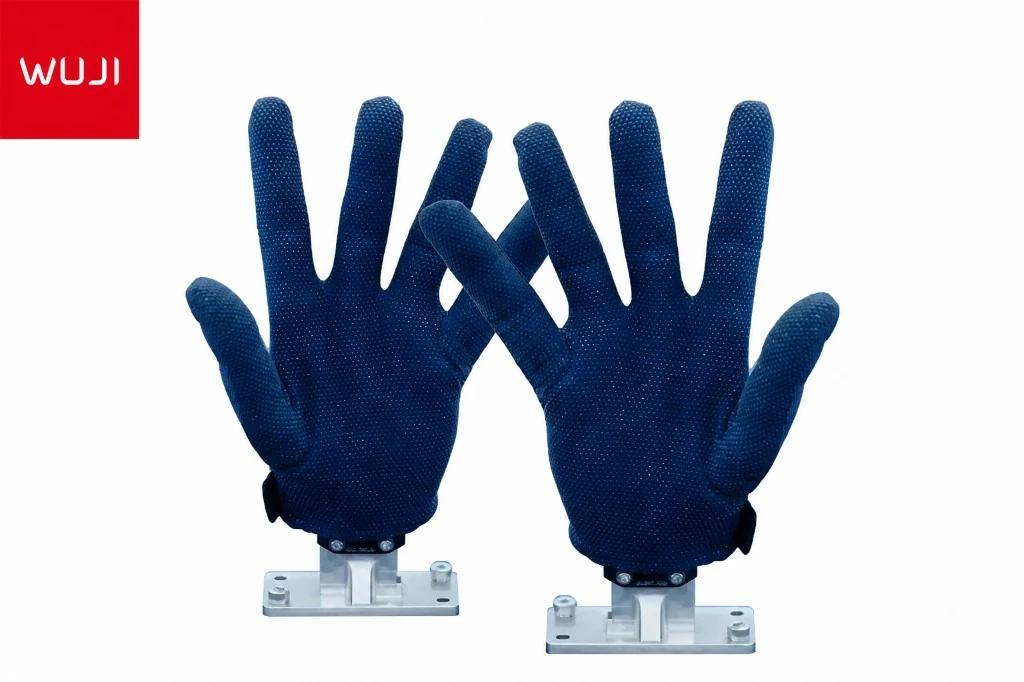
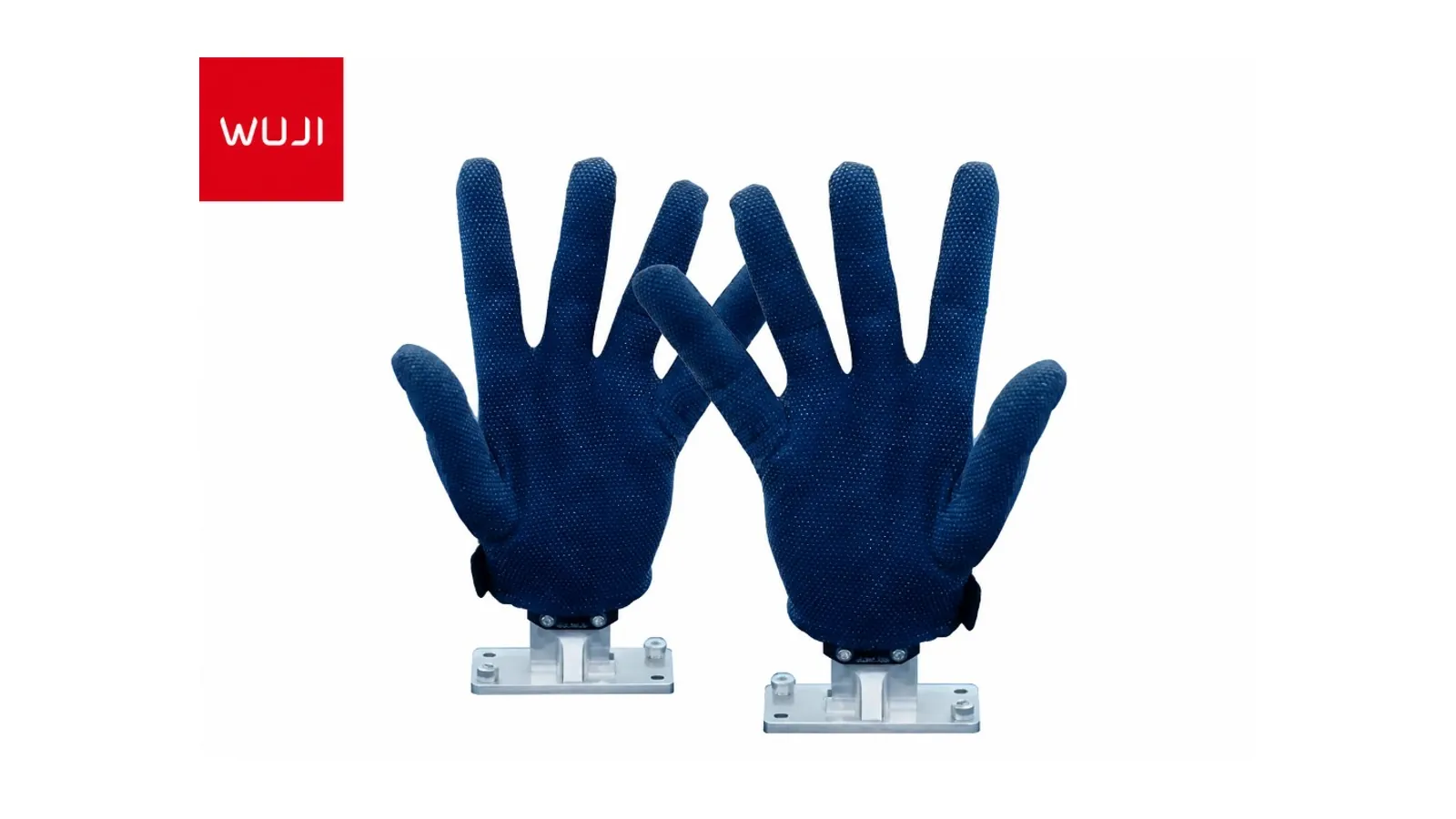
The Wuji Glove$4,500.00 combines two signals in one glove. On the palm side it has a 24 × 31 pressure matrix with 526 effective sensing points, 0.1 N resolution over a 0–20 N range and 120 FPS output; on the fingertips it has five EMF modules that track 6-DoF pose at 120 Hz with position accuracy of 2 mm RMS or better and motion-to-data latency of 10 ms or less.11 A six-axis IMU on the back of the hand runs at 800 Hz, and the glove weighs 67.5 g without cables.11 Wuji provides an SDK in Python and C and a command-line tool for calibration, live visualization and JSONL data capture.11
Good fit for: teleoperating a Wuji Hand or another dexterous hand when you want fingertip tracking and palm contact data from the same glove, recorded on one clock. See our Wuji Hand teleoperation guide for a worked setup.
How to choose
Start from the signal your robot or dataset needs, then narrow by integration:
- Retargeting onto a robot hand? Fingertip position is the most direct input. The Wuji Glove and the MANUS Metagloves Pro both track fingertip pose with EMF sensors at 120 Hz.411
- Need contact data? A tactile glove adds what cameras miss. The Wuji Glove records palm pressure alongside fingertip tracking;11 the RC G1 (our product) is a light, dedicated pressure glove that pairs with a separate tracker.8
- Want the operator to feel contact? Look at the MANUS Metagloves Pro Haptic for vibration feedback6 or LinkerBot's force-feedback glove for grip resistance.3
- Locked to one robot hand? A matched glove saves integration time: LinkerBot gloves for LinkerBot hands, the Wuji Glove for the Wuji Hand.
- Long sessions and many operators? Weight, wireless range and battery swaps matter. Compare battery and connection details in the table above and in our ergonomics notes.
- Software stack. If you run ROS 2, MANUS documents a ROS 2 package;5 Wuji and UDEXREAL provide Python and C or C++ SDKs that are simple to wrap.1011
In short: if you need fingertip tracking and palm pressure in one glove, choose the Wuji Glove. If a mature SDK with ROS 2 support and optional vibration feedback matters more, choose MANUS Metagloves Pro or Pro Haptic. If comfort and joint-angle capture over long sessions come first, choose the UDEXREAL UDCAP. If your robot is a LinkerBot hand, choose LinkerBot's own gloves. If you mainly need a thin contact-sensing glove for grasp research, consider the RC G1 Tactile Glove (our product).
Next steps
- Compare specs side by side in the data glove comparison, and pick the robot hand in the dexterous hand comparison.
- Read the glove-based dexterous teleoperation guide for setup and retargeting.
- Not sure which glove matches your hand and stack? Talk to us and we will help you scope it.
Sources
- Wang et al., "DexCap: Scalable and Portable Mocap Data Collection System for Dexterous Manipulation," arXiv:2403.07788. https://arxiv.org/abs/2403.07788 (accessed November 2026) ↩
- LinkerBot, Linker MCG motion-capture glove product page. https://www.linkerbot.cn/details/LinkerMCG (accessed November 2026) ↩
- LinkerBot, Linker FFG force-feedback glove product page. https://www.linkerbot.cn/details/LinkerFFG (accessed November 2026) ↩
- MANUS, Metagloves Pro technical specs. https://www.manus-meta.com/products/metagloves-pro-specs (accessed November 2026) ↩
- MANUS Knowledge Center, SDK and ROS 2 documentation. https://docs.manus-meta.com/latest/ (accessed November 2026) ↩
- MANUS, Metagloves Pro Haptic technical specs. https://www.manus-meta.com/products/metagloves-pro-haptic-specs (accessed November 2026) ↩
- MANUS, Quantum Metagloves product page (legacy). https://www.manus-meta.com/products/quantum-metagloves (accessed November 2026) ↩
- Robotics Center, RC G1 Tactile Glove product page (product specifications). https://www.roboticscenter.ai/store/product/rc-g1-tactile-glove (accessed November 2026) ↩
- UDEXREAL, UDCAP Data Glove product introduction. https://udexreal.gitbook.io/udexreal-docs/udexreal-udcap-dataglove-product-introduction (accessed November 2026) ↩
- UDEXREAL, Usage for UDEXREAL robotics products. https://udexreal.gitbook.io/udexreal-docs/robotics/usage-for-udexreal-robotics-products (accessed November 2026) ↩
- Wuji, Wuji Glove introduction (official documentation). https://docs.wuji.tech/docs/zh/wuji-glove/latest/introduction (accessed November 2026) ↩