

YAM and Franka Teleoperation Data: Custom Collection for Robot Learning
Request teleoperation data recorded on I2RT YAM or Franka arms: the signals and cameras an episode can include, quality checks, LeRobot / HDF5 / RLDS delivery, data ownership and what to send for a quote.
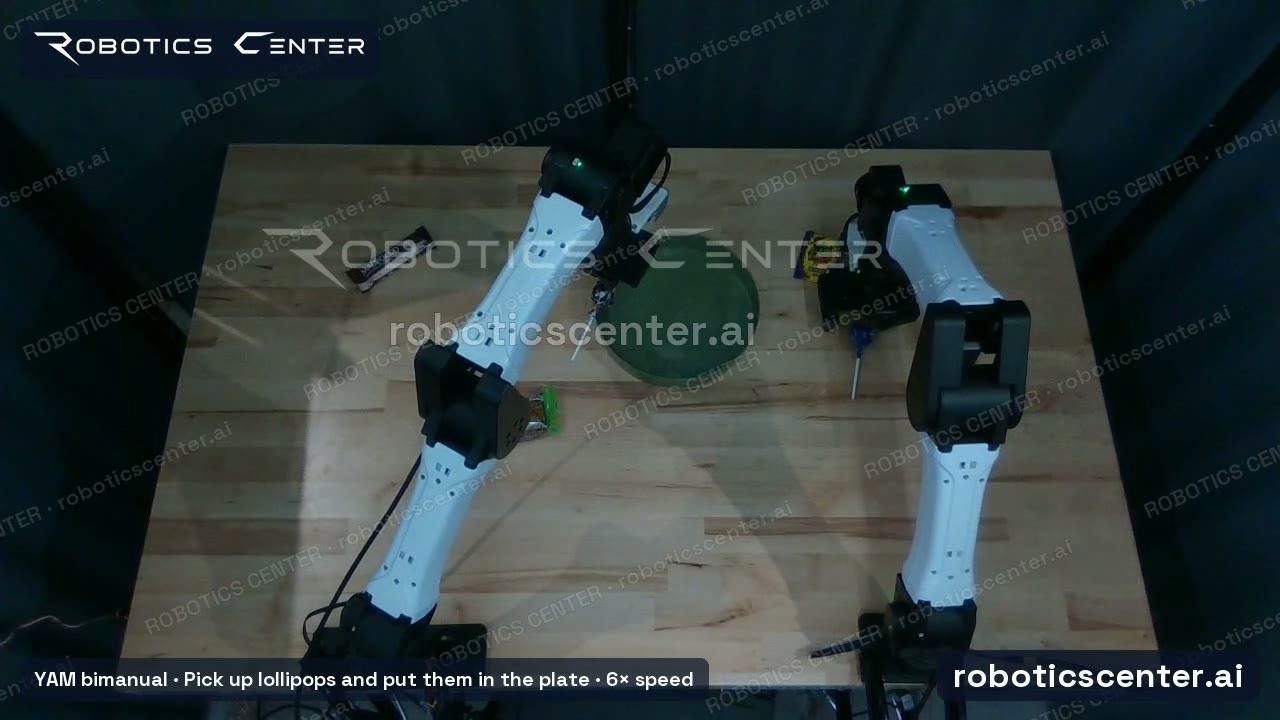
Need demonstration data on an I2RT YAM or a Franka arm? We collect new teleoperation data to your specification: you define the task, the sensors and the acceptance criteria, operators record the demonstrations, and each episode is checked before delivery.
This page lists what to decide before a project starts, so that the first quote can be specific. For the full process and quality targets, see Teleoperation Data Collection.
Who this is for
Research labs and robotics teams that train their own policies and need demonstrations on the arm they will deploy. Send the request to us directly, so that the people scoping your collection hear the task, the format and the acceptance criteria from you.
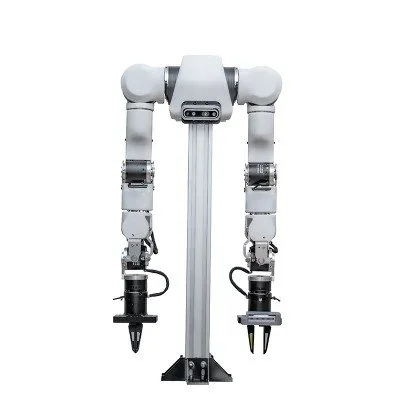
Robots: YAM and Franka
| Arm | Data collection |
|---|---|
| I2RT YAM | Single-arm or bimanual. See the YAM arm family |
| Franka | Single-arm or bimanual |
For Franka, tell us whether your policy needs the Franka Research 3 (FR3) or the earlier Franka Emika Panda. They are different robots, and we confirm in writing which one a quote covers.
On Franka, we offer data collection only. We do not sell or lease Franka hardware, and Robotics Center is not affiliated with Franka Robotics.
The number of stations, operators and recording hours available depends on your task and dates. We confirm capacity and the start date in the quote.
New collection or an existing dataset
- New collection is recorded for your task, on the arm, cameras and scenes you specify.
- Existing datasets that can be ordered today are listed in the data marketplace. Each listing states its recording setup, modalities, format, sample and price per recorded hour. Check the listing before assuming it matches your robot.
What an episode can include
| Signal | Contents | Typical rate |
|---|---|---|
| Joint states | Position, velocity, effort | 20–100 Hz |
| Actions | Commands from the operator interface | Fixed in the brief |
| RGB cameras | Head or overhead, wrist, side | 30–60 FPS |
| Depth cameras | Aligned depth with intrinsics | 15–30 FPS |
| End-effector pose | Position and orientation | 20–100 Hz |
| Gripper state | Position, force, open or close | 20–100 Hz |
| Labels | Success or failure, task phases, language instructions | Per episode or frame |
Streams are aligned to one task timeline with monotonic timestamps. Which signals are available depends on the arm and the sensors in your setup; exact rates and tolerances are fixed in the collection brief. Our quality targets and 10-point episode checklist cover timing, frame loss, task success and metadata.
What to decide in your request
- Arm and setup. Which YAM or Franka model; single-arm or bimanual; gripper or other end effector.
- Tasks. What the robot does, what counts as success, and how much objects, positions and scenes should vary.
- Cameras. How many, where they are mounted, and the minimum resolution and frame rate.
- Signals and timing. Which streams you need, their minimum rates, and the camera-to-action sync tolerance.
- Calibration and robot model. The camera intrinsics and extrinsics, coordinate frames and robot description (URDF) your pipeline expects.
- Episode labels. Success and failure labels, whether failed episodes should be delivered, and any language annotations.
- Format. HDF5, RLDS / TFRecord, LeRobot or your own schema. If you need a particular LeRobot version, name it.
- Volume and dates. Demonstrations or hours for each arm, the delivery date, and whether partial or weekly batches help.
- How volume is counted. For hour-based projects, agree what an accepted recorded hour is before collection starts: which episodes count, and whether resets and failed attempts are included.
- Use of the data. Whether you will train commercial models, and any other terms your team requires. These go into the agreement.
Delivery formats
| Format | Works with |
|---|---|
| LeRobot (Parquet) | Hugging Face LeRobot |
| HDF5 | ACT, ALOHA, robomimic |
| RLDS / TFRecord | Open X-Embodiment, Octo |
| Custom | Your training stack |
See HDF5 vs RLDS vs LeRobot for the trade-offs.
Pricing
Data collection on YAM and Franka arms is quoted per project. The price depends on the task, the number of camera views, the signals you need, the volume and the delivery date. Send us the points above and we will reply with a scope and a quote. A small pilot is a good first step to check real episodes in your format before ordering volume.
Data ownership
We sign mutual NDAs before discussing proprietary tasks or robot configurations. Data collected under contract is owned by the client. We do not use client data for other purposes or include it in public datasets. Existing marketplace datasets are licensed separately, under the RC Standard Data License.
Common questions
Can you collect data on both YAM and Franka in one project?
Yes, it can be scoped as one project. Give the volume you need for each arm separately, so that capacity, schedule and price can be confirmed for each.
Can we see a sample first?
Marketplace listings show what sample is available for each existing dataset. For new collection on your task, the pilot is how you check real episodes in your format before ordering volume.
We do not have a robot. Is that a problem?
No. We can scope the project on an arm provided for the collection. If you want a YAM setup for evaluation or deployment, see the YAM arm family.
Request a quote
Send us the points above, even if some are still open. Request a quote or email contact@roboticscenter.ai.