

Humanoid Robots in 2026: The Complete Market Overview
Humanoid robots in 2026: who makes them, what each platform is built for, published specs, live prices for the models you can buy today, and how to decide between buying, leasing and waiting.
Part of: Humanoid Robot Buyer's Guide
Humanoid robots moved from research projects to products you can order faster than most analysts expected. This overview covers who the main players are in 2026, what each platform is designed to do, and how to decide whether to buy, lease or wait. Specifications come from each maker's own pages and are footnoted; prices for robots we sell are live store prices.
Comparing specific models? Put up to three humanoids side by side in the humanoid comparison, see the best humanoids under $20k for entry-level options, or read our head-to-head Unitree G1 vs Tesla Optimus.
Disclosure: Robotics Center sells and leases several of the robots below (marked with a live price chip). Robots we do not sell link to the maker's own page.
Why humanoids, why now
The practical case for the humanoid form is that the world is built for people. Doors, stairs, shelves and workbenches are sized for a two-armed, two-legged body, so a robot with the same shape can in principle work in existing spaces without rebuilding them. The technical case is that imitation learning now lets teams teach manipulation skills by demonstration instead of hand-writing controllers. The ACT policy, for example, learned fine-grained bimanual tasks such as slotting a battery from about 10 minutes of demonstrations, with 80–90% success on six real-world tasks.1
Labor availability in manufacturing, logistics and services is the main economic driver, and it has drawn significant investment into the sector.
Investment: where the capital is going
Two of the largest recent rounds illustrate the scale:
| Company | Round | Announced | Source |
|---|---|---|---|
| Figure AI | Series C, more than $1 billion committed, $39 billion post-money valuation | September 16, 2025 | Figure2 |
| Apptronik | Series A, $403 million in total after a $53 million extension | March 18, 2025 | Apptronik3 |
What this means for buyers: heavy investment funds faster product iteration and growing support ecosystems. It also means the market will consolidate over time, so it pays to check a vendor's support model and spare-parts plan before buying.
Market players in 2026
The platforms below are grouped by what they are built for. Within each group they are listed alphabetically.
Research, education and development platforms
These robots are sold openly with SDKs, and they are where most labs, universities and startups begin.
AGIBOT X2
The AGIBot X2From $27,999.00 is a compact humanoid of about 1.31 m and 35 kg with 25 degrees of freedom and a battery of about 500 Wh, rated for roughly 2 hours of walking at 0.5 m/s.4 AGIBOT highlights multimodal interaction (voice, vision, touch and facial expressions); the X2 Ultra adds autonomous navigation and obstacle avoidance.4 AGIBOT also builds the full-size AGIBot A2$112,000.00 line for service and commercial settings.
Good fit for: interactive and service-robot research, demonstrations and teams that want an expressive, compact platform.
Booster K1
The Booster K1From $11,998.00 is a kid-size humanoid of about 95 cm and 19.5 kg with 22 degrees of freedom.5 Booster positions it as an introductory embodied-AI platform for the classroom, the competition field and the lab, with Python and C++ SDK support; the Education and Professional editions run up to 70 minutes of walking on a 5 Ah battery.5 Booster's larger platforms, including the Booster T1Request a Quote, cover full-size research needs.
Good fit for: teaching, robot soccer and competition teams, and labs that want an affordable, light platform that is easy to handle.
Unitree G1
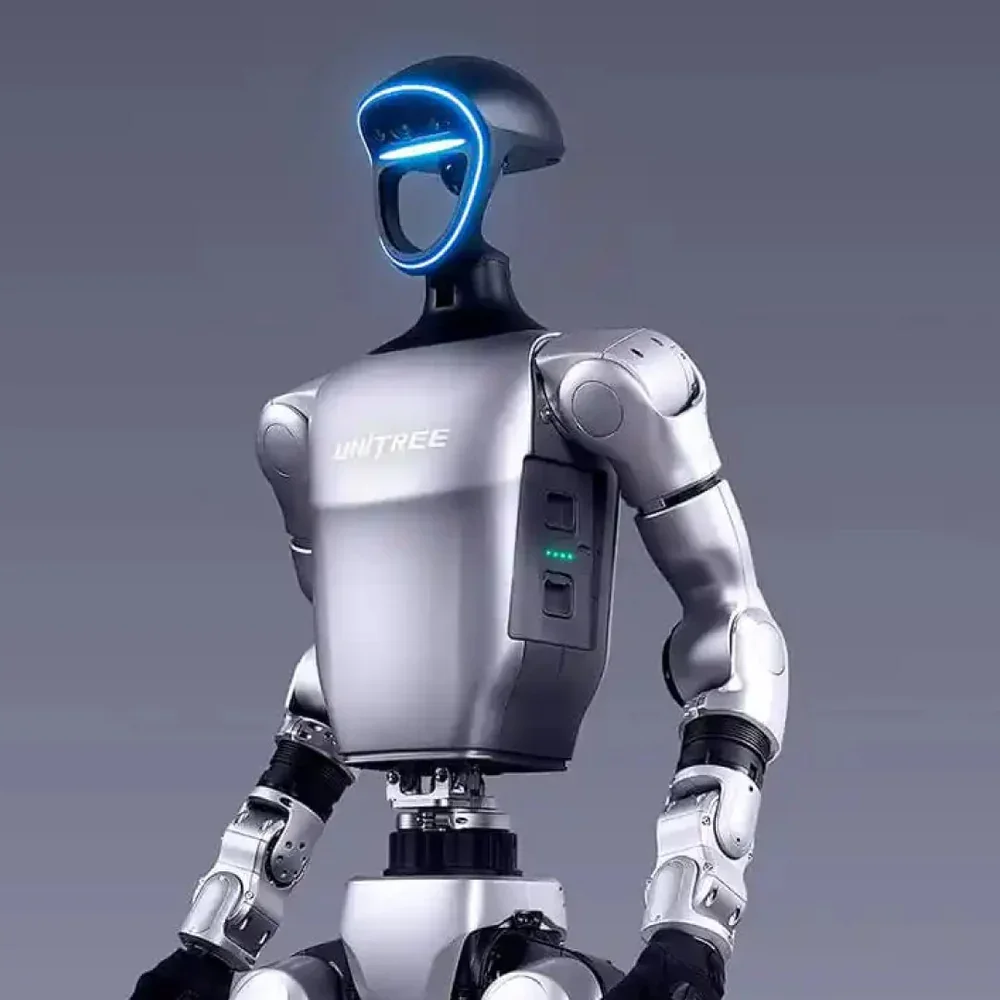
The Unitree G1$21,500.00 is the most widely available research humanoid. Unitree lists it at 1320 mm tall and about 35 kg with 23 degrees of freedom, expandable to 23–43 on the EDU versions, an arm load of about 2 kg (about 3 kg on EDU) and about 2 hours of battery life from a quick-release 9000 mAh pack.6 EDU versions add an optional high-performance compute module.6 Our Unitree G1 EDU-U1$43,800.00 configuration is the usual starting point for manipulation research and data collection. See our Unitree G1 review.
Good fit for: university labs, sim-to-real and locomotion research, teleoperation and data collection, and teams that value a large developer community.
Unitree R1 and H2
The Unitree R1$6,270.00 is Unitree's entry humanoid: 1230 mm tall, about 29 kg, with 26 degrees of freedom (26–40 on EDU) and about 1 hour of battery life.7 For full-size research Unitree offers the Unitree H2$40,800.00.
Good fit for: the R1 suits education, outreach and first humanoid projects on a tight budget; the H2 suits teams that need human-scale reach.
Industrial and logistics platforms
These robots are typically deployed through enterprise programs with the maker rather than bought off the shelf.
Agility Robotics Digit
Agility describes Digit as a humanoid with 65,000 hours of real production experience, built for industrial environments and assembled in Salem, Oregon.8 Named customers include GXO, Schaeffler and Toyota Motor Manufacturing Canada.8 See Agility Robotics for deployment programs.
Good fit for: warehouse and logistics operations that want a humanoid with a long production track record, delivered with fleet software and support.
Apptronik Apollo
Apptronik designs Apollo for physically demanding, repetitive work in manufacturing, logistics and retail, with bipedal or wheeled mobility depending on the site.9 Its commercial customers include Mercedes-Benz and GXO, and its partners include Google DeepMind, NVIDIA and Jabil.39
Good fit for: manufacturers and logistics operators who want an enterprise partner for a structured industrial deployment.
Home and general-purpose platforms
1X NEO
1X builds NEO as a home robot for everyday household tasks. 1X lists it at 5'6" and 66 lb.10 Pre-orders opened in October 2025 at $20,000 to buy or $499 per month, with home deliveries starting in the US in 2026 and other markets planned from 2027.11 See 1X.
Good fit for: early adopters who want a humanoid designed around safety and everyday tasks in the home.
Figure 03
Figure introduced Figure 03 on October 9, 2025 as a robot for both homes and workplaces, with washable soft goods, fingertip sensors that detect forces as small as three grams, and inductive charging through the feet.12 Figure says its BotQ facility is initially expected to produce up to 12,000 humanoids per year.12 See Figure.
Good fit for: enterprise partners working with Figure on deployments, and observers tracking the leading edge of general-purpose humanoids.
Tesla Optimus
Tesla's Optimus program is covered in depth in our Unitree G1 vs Tesla Optimus comparison and our Optimus price and availability guide.
Published specifications
Figures below are the makers' own published values. A dash means the maker does not publish that figure on the page we cite.
| Robot | Height | Weight | Total DOF | Battery | How to get one |
|---|---|---|---|---|---|
| 1X NEO | 5'6"10 | 66 lb10 | — | — | Pre-order from 1X11 |
| AGIBOT X2 | ~1.31 m4 | ~35 kg4 | 254 | ~2 h walking at 0.5 m/s4 | From $27,999.00 at our store |
| Booster K1 | ~95 cm5 | ~19.5 kg5 | 225 | Up to 70 min walking (Edu/Pro)5 | From $11,998.00 at our store |
| Unitree G1 | 1320 mm6 | ~35 kg6 | 23 (EDU 23–43)6 | ~2 h6 | $21,500.00 at our store |
| Unitree R1 | 1230 mm7 | ~29 kg7 | 26 (EDU 26–40)7 | ~1 h7 | $6,270.00 at our store |
For Digit, Apollo and Figure 03, the makers do not publish a full spec sheet on the pages cited here; contact them for deployment specifications.
What humanoids do well today
This is our editorial view of where the technology stands, based on public demonstrations and the deployments described above. It is a guide to setting expectations, not a measurement.
| Capability | Where it stands in 2026 |
|---|---|
| Indoor walking on flat floors | Reliable on leading platforms |
| Pick-and-place of known objects in structured settings | Working in pilots and early deployments |
| Bimanual manipulation of trained tasks | Works well on the tasks a policy was trained for |
| Handling novel objects | Improving quickly with foundation models; usually needs task data |
| Dexterous in-hand manipulation | Promising research demonstrations |
| Long unsupervised operation | Limited by battery life and error recovery |
| General-purpose task learning | Active research frontier |
The labor economics framework
The business case for a humanoid comes down to comparing the cost of the robot program with the cost of the work it covers. The inputs that matter:
- Robot cost: purchase or lease price, plus spare batteries, hands and sensors.
- Integration cost: data collection, policy training and deployment engineering. In year one this is often comparable to the hardware itself.
- Running cost: maintenance, support and energy.
- Throughput: how much of a person's output the robot delivers on the task, at what success rate, and for how many hours a day.
- Labor cost and availability for the same task, including shift premiums and hiring difficulty.
The case is strongest in three situations:
- Labor shortage. When a shift cannot be staffed at any reasonable wage, the robot only has to be available, not cheaper.
- Multi-shift operation. A robot that runs across shifts spreads its fixed cost over more hours.
- Hazardous or ergonomically hard work. When the true cost of a task includes safety measures and strain injuries, automation pays back faster.
Contact us and we can build the model with your own numbers.
Deployment realities
Data collection is the main effort
The biggest barrier to deployment is usually not the hardware but teaching the robot each new task. Imitation learning policies such as ACT learn from teleoperated demonstrations,1 and a facility with many distinct tasks needs demonstrations for each of them. This is where our data collection services help: trained operators, standardized collection pipelines and quality checks.
Recovery from failure
Demonstrations show success; production also has to handle the dropped part, the unexpected object or the degraded sensor. Most deployments today keep a person nearby to reset after a failure, which is why the first production tasks are ones with very high success rates.
A deployment pattern that works
Teams that succeed usually follow the same path:
- Pick one simple, repetitive task in a structured area and complete a safety assessment.
- Collect demonstrations, train a policy and run it with close human oversight.
- Improve reliability by collecting more demonstrations for the failure cases.
- Reduce oversight once the task is reliable, then start on the second task.
- Build in-house expertise and expand task by task.
Teams that start with many tasks at once tend to progress more slowly than teams that start narrow.
When to buy, lease or wait
Buy or lease now if
- You need a humanoid embodiment for data collection or AI training datasets
- You run a research program that needs real-hardware experiments
- You have a well-scoped task in a structured environment and resources for data collection and integration
- You want early hands-on experience to build internal capability
- You face a labor availability problem, not only a cost problem
Wait if
- You need deployment across many varied tasks without engineering investment
- You need guaranteed uptime in a critical production line
- Your tasks depend on dexterous in-hand manipulation that has not yet been shown reliably for your use case
- You need a return on investment within a few months
The leasing middle ground: if you are unsure, leasing lowers the risk. A lease, quoted per project, gives you time to test feasibility on your own task before committing capital.
How to choose
If you need an affordable, widely supported research platform with a large community, choose the Unitree G1. If teaching, competitions or a light, easy-to-handle robot matter more, choose the Booster K1. If your budget is tight and you want a first humanoid for education or outreach, choose the Unitree R1. If expressive interaction is central to your work, consider the AGIBOT X2. If you run industrial or logistics operations and want an enterprise deployment partner, talk to Agility Robotics or Apptronik. If you want a humanoid designed for the home, follow 1X NEO and Figure 03.
Our humanoid lineup
We stock and support the humanoids below for sale and lease from our San Francisco facility, with setup support, teleoperation training and data collection services.
| Platform | Purchase | Lease | Best for |
|---|---|---|---|
| AGIBOT X2 | From $27,999.00 | Quote | Interaction research, demos |
| Booster K1 | From $11,998.00 | Quote | Teaching, competitions, light research |
| Unitree G1 (base) | $21,500.00 | Quote | Research labs, early prototyping |
| Unitree G1 EDU-U1 | $43,800.00 | Quote | Manipulation research, data collection |
| Unitree R1 | $6,270.00 | Quote | Education, first humanoid projects |
| Data collection add-on | Quote | Quote | Teleoperation setup, operator training, data pipeline |
Browse the store for current availability, compare models in the humanoid comparison, or contact a solutions engineer to discuss which platform fits your use case.
Related reading
Humanoid comparison · Best humanoids under $20k · Unitree G1 vs Tesla Optimus · Unitree G1 review · Robot leasing · Physical AI in 2026 · Robotics glossary
Sources
- Zhao, Kumar, Levine, Finn, "Learning Fine-Grained Bimanual Manipulation with Low-Cost Hardware" (ACT), arXiv:2304.13705. https://arxiv.org/abs/2304.13705 (accessed November 2026) ↩
- Figure AI, Series C funding announcement, September 16, 2025. https://www.figure.ai/news/series-c (accessed November 2026) ↩
- Apptronik, press release on closing additional Series A funding ($403M total), March 18, 2025. https://apptronik.com/news-collection/apptronik-closes-additional-series-a-funding (accessed November 2026) ↩
- AGIBOT, X2 product page. https://www.agibot.com/products/X2 (accessed November 2026) ↩
- Booster Robotics, Booster K1 product page. https://www.booster.tech/booster-k1/ (accessed November 2026) ↩
- Unitree Robotics, G1 product page. https://www.unitree.com/g1/ (accessed November 2026) ↩
- Unitree Robotics, R1 product page. https://www.unitree.com/R1/ (accessed November 2026) ↩
- Agility Robotics, home page. https://www.agilityrobotics.com/ (accessed November 2026) ↩
- Apptronik, home page (Apollo). https://apptronik.com/ (accessed November 2026) ↩
- 1X Technologies, NEO product page. https://www.1x.tech/neo (accessed November 2026) ↩
- The Robot Report, coverage of the 1X NEO pre-order launch, October 30, 2025. https://www.therobotreport.com/1x-announces-pre-order-launch-neo-humanoid-robot/ (accessed November 2026) ↩
- Figure AI, "Introducing Figure 03," October 9, 2025. https://www.figure.ai/news/introducing-figure-03 (accessed November 2026) ↩