






 01
01Teleop: Hand + Glove
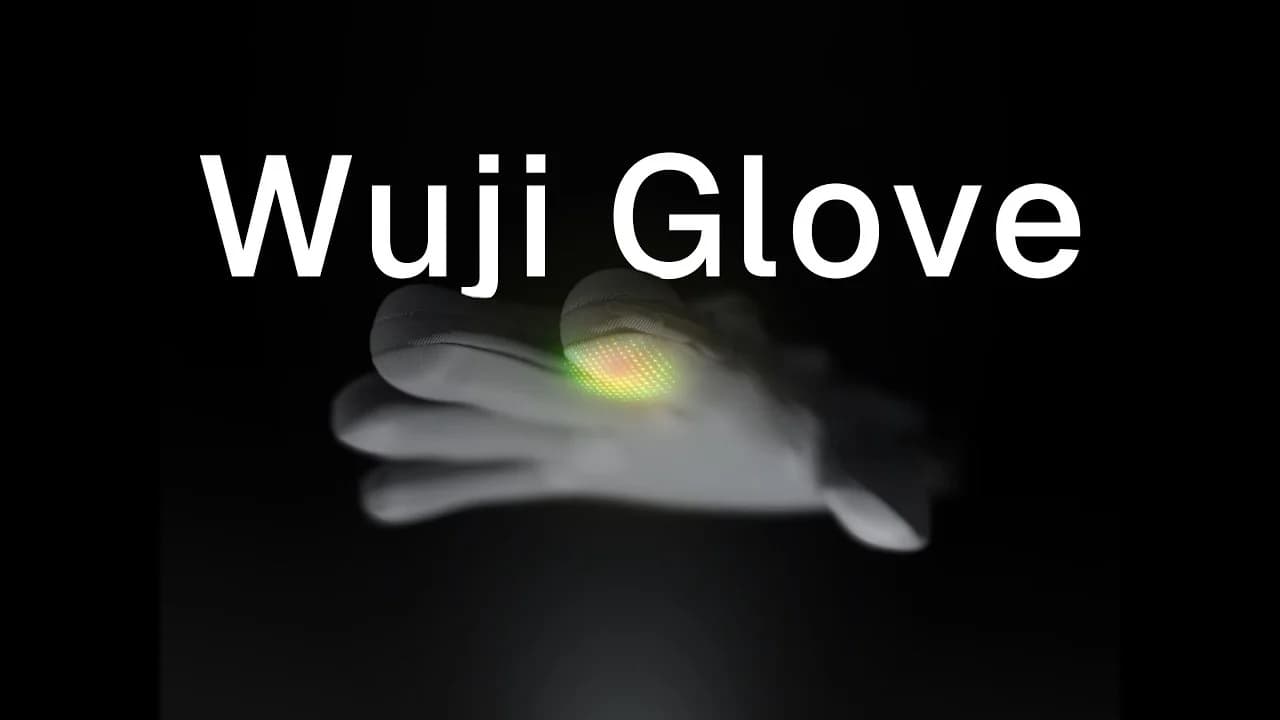
A tactile glove drives the robot hand while we record fine-finger teleoperation data.
- Data
- Finger pose, joint angles, tactile signals, and robot state.
- Best for
- Fine manipulation, contact-rich skills, and grasp diversity.

Collect teleoperation data, Universal Manipulation Interface (UMI) data, and egocentric demonstrations for dexterous robot hands—single-hand or bimanual.
Compare glove-based hand teleoperation, VR arm-and-hand teleoperation, egocentric capture, and UMI workflows for your task.
01A tactile glove drives the robot hand while we record fine-finger teleoperation data.
VR tracks the arm while a glove controls the fingers, producing synchronized arm-and-hand teleoperation data.
 03
03A person performs the task while first-person video and touch are recorded.
A lightweight first-person setup captures human task demonstrations at volume.
A tracked handheld gripper records portable demonstrations for transfer to a robot setup.
Keep your training and deployment embodiment aligned with hardware sourced through RCSV.
Share the method, hardware, configuration, and rough hours. We’ll reply with the right pilot scope and matching paperwork.
See representative egocentric workflows across food preparation, object organization, and garment handling.
Every project starts with an agreed stream list and ends with a format and quality report your team can use immediately.
Head, wrist, side, or overhead views aligned to the task timeline.
Finger configuration and embodiment state for every demonstration.
Contact and touch streams when the selected glove or hand supports them.
Arm, hand, gripper, pose, and action streams defined in the project brief.
Success, failure, phase, and custom labels agreed during scoping.
A four-step path keeps technical risk at the front and gives your team a concrete checkpoint before production collection.
Choose the task, method, hardware, views, signals, and acceptance criteria.
Validate operator workflow, synchronization, schema, and task quality on a small batch.
Scale the approved setup with trained demonstrators and monitored sessions.
Review the data, package the selected format, and hand off the QA report.
Quick answers about scope, timing, formats, and visiting the lab.
Start a quoteDexterous hand teleoperation data records a human operator controlling a multi-finger robot hand. A dataset can include synchronized video, finger joint states, actions, tactile signals, and robot state for imitation learning.
Universal Manipulation Interface (UMI) data collection uses a tracked handheld gripper and camera to capture portable manipulation demonstrations, including video, gripper state, pose, timestamps, and task labels.
Minimum size depends on the collection method, hardware, and task complexity. We recommend a pilot large enough to validate the workflow before full collection.
Most pilots take 1–2 weeks. Full collection programs typically take 2–6 weeks; complex bimanual setups may take longer.
Yes. We define the task steps, variations, reset conditions, success criteria, and labels, then validate the workflow in a pilot.
We deliver HDF5, RLDS/TFRecord, LeRobot/Parquet, or an agreed custom schema. Every delivery includes validated structure and metadata.
Yes. Schedule a visit to our data collection lab at 90 Welsh St in San Francisco to review hardware or scope a pilot.
