







Robot End Effectors: Types, Specs & Where to Buy (2026 Guide)
Complete guide to robot end effectors: parallel grippers, dexterous hands, vacuum cups, and tactile sensors. Compare Robotiq 2F-85, Wuji Hand, and Allegro Hand. Specs, pricing, and how to choose for your application.
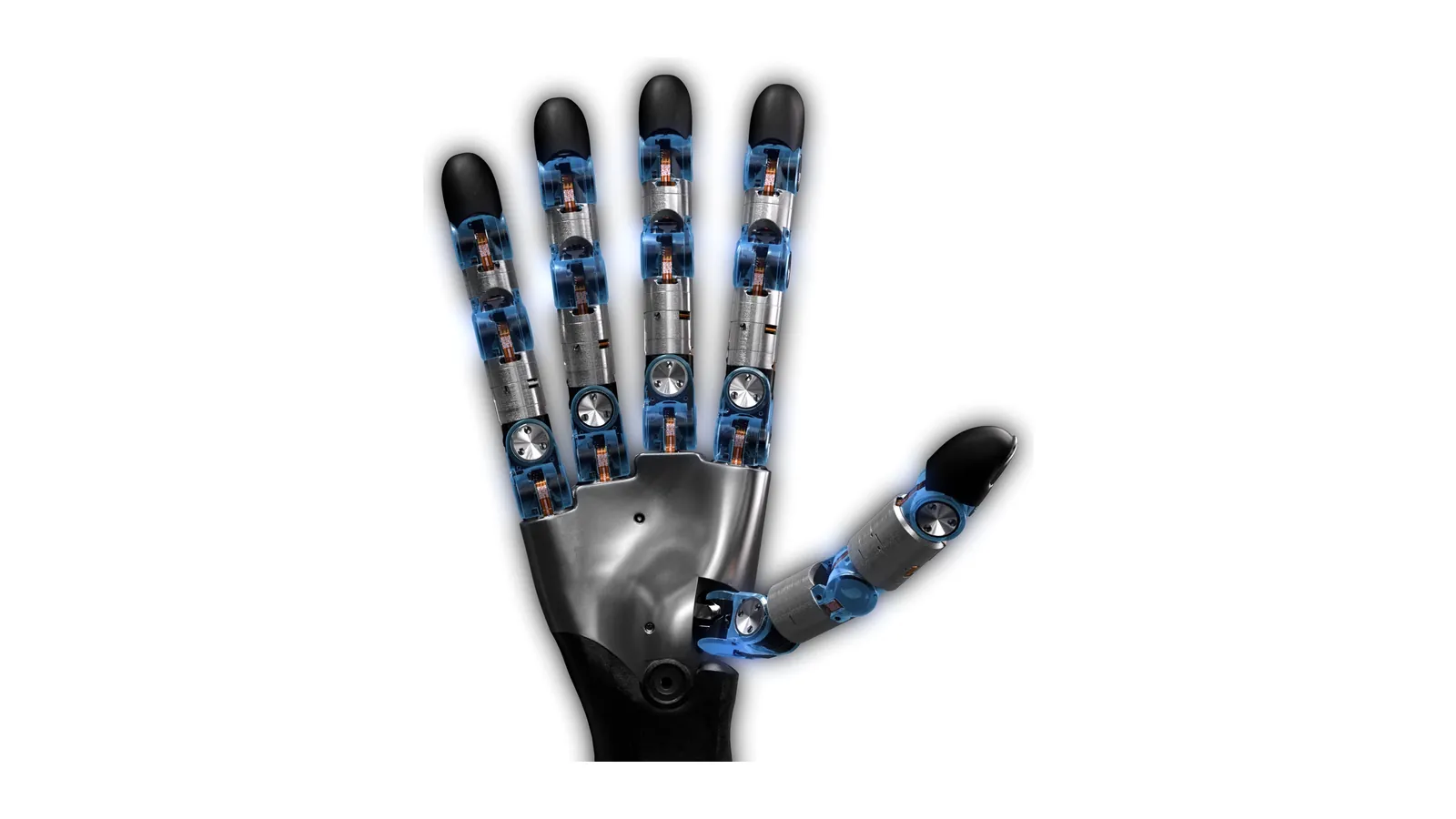
The end effector is the single most task-critical component on any robot arm. Everything else — the arm, the controller, the training data — only matters if the end effector can physically interact with the objects you care about. This guide covers the major end effector categories, what specifications matter and why, how to compare options, and which products RCSV recommends for common manipulation and research applications.
Contents
- What Is a Robot End Effector?
- Types of End Effectors
- How to Choose: Key Specifications
- Products at RCSV
- Comparison Table
- Use Cases: Pick-and-Place, Teleoperation, Imitation Learning
- FAQ
What Is a Robot End Effector?
A robot end effector is the device attached to the terminal link of a robot arm — the part that touches and manipulates the world. The name comes from the functional role: it is the effector of the arm's motion, the component that actually effects change on objects in the environment. In industrial settings, end effectors are also called EOAT (end-of-arm tooling).
The robot arm itself provides positioning: it moves the end effector to the right location with the right orientation. The end effector provides actuation: it grabs, releases, pushes, cuts, welds, or otherwise interacts with the object. These are distinct engineering problems. A robot arm with a suboptimal end effector for the task will fail regardless of how good the arm kinematics are.
For robotics researchers and engineers building imitation learning systems or manipulation pipelines, the end effector choice is especially consequential. The training data format, the state representation, the reward function, and the task definition all depend on what kind of end effector you are using. Switching end effectors mid-project typically means collecting new data from scratch.
Types of End Effectors
1. Parallel Jaw Grippers
The most common end effector type in research and industry. Two parallel fingers close symmetrically around an object. Simple, reliable, and well-supported across all major robot arm platforms. The Robotiq 2F-85 is the industry standard: 85 mm stroke and 20 to 235 N of grip force, per Robotiq, with RS-485 and USB communication and force and position control. It is used in the vast majority of published imitation learning and pick-and-place research.
Parallel grippers excel at grasping objects with predictable geometry — cylinders, boxes, flat objects with consistent edges. They struggle with deformable objects (cloth, bags), objects with complex surface geometry, and tasks requiring fingertip-level precision. For most tabletop manipulation benchmarks, a parallel gripper is the right choice and any other option adds complexity without commensurate benefit.
Key variants: 2-finger (Robotiq 2F-85, OnRobot RG6), 3-finger (Robotiq 3F for cylindrical objects), wide-stroke (for large objects), miniature (for precision assembly).
When you size a parallel gripper, three numbers decide it: stroke (the opening must exceed your widest object at the angle you approach it), grip force (enough to hold your heaviest object through the accelerations of transport, with margin), and repeatability (what precision insertion depends on). Robotiq's two research staples show the trade-off between stroke and force:
| Spec (Robotiq) | 2F-85 | 2F-140 |
|---|---|---|
| Stroke | 85 mm | 140 mm |
| Grip force | 20 to 235 N | 10 to 125 N |
| Payload | 5 kg | 2.5 kg |
| Closing speed | 20 to 150 mm/s | 30 to 250 mm/s |
| Repeatability | 0.05 mm | 0.08 mm |
| Weight | 1 kg | 1 kg |
| Ingress protection | IP40 | IP40 |
| Store price | $5,990.00 | $5,995.00 |
Source: Robotiq. The wider 2F-140 opens to 140 mm but holds half the payload, so pick it only when your objects really are too wide for the 2F-85.
2. Adaptive / Underactuated Grippers
Adaptive grippers use mechanically compliant fingers that conform to object shape during grasping. A single actuator drives multiple joints in each finger, with the joint motion governed by the contact mechanics rather than independent position control. This means the gripper can grasp irregular objects, spheres, and deformable items without needing precise pre-grasp positioning.
The Robotiq Hand-E is the most common industrial adaptive gripper, with parallel-jaw precision and adaptive capability in one unit. For research, adaptive grippers reduce the difficulty of robust grasp planning because contact tolerance is built in mechanically rather than requiring it from the policy.
3. Vacuum / Suction Cup Grippers
Suction grippers use vacuum pressure to grip flat, smooth, non-porous surfaces. They are the dominant end effector in logistics and e-commerce automation because boxes and flat-packed items are ideal suction targets. A well-designed vacuum system can achieve grasps in under 100ms and handle a wide range of object sizes without mechanical reconfiguration.
Suction grippers fail on porous materials (fabric, foam), curved surfaces where the cup cannot form a seal, and heavy objects that exceed the vacuum force. For research, they are primarily used in bin-picking and sorting applications where the object set is constrained to flat, smooth items.
A suction cup also tells you little about the object once it is held: you know something is attached, but not its orientation or where it sits relative to the cup. Choose suction when objects are flat-topped and smooth (boxes, panels, sealed packages), too wide for any jaw, or when placement orientation does not matter. Choose a parallel jaw when objects are small, cylindrical or irregular, porous or wet, or must be placed precisely. When a task mixes both kinds of object, a tool changer lets one arm swap between a suction tool and a jaw, at the cost of extra weight at the wrist and one demonstration dataset per tool.
Soft and Magnetic Grippers
Soft grippers use compliant materials (silicone, elastomers, inflatable chambers) that conform to the object, so they need little grasp planning and rarely damage what they hold. Pneumatic soft fingers inflate around the object and need an air supply; cable-driven designs such as FinRay-style fingers bend around the object with simple actuation and no compressed air. They suit produce, baked goods and irregular items picked from bins, and trade away grip force and placement precision to get that gentleness.
Magnetic grippers hold ferrous parts (steel, iron) regardless of oil, dust or surface shape, with no grasp planning. Electromagnets grip while powered; electro-permanent magnets switch state with a short pulse and then hold without power. The limit is absolute: they cannot pick aluminum, plastic, wood or glass, so they belong in sheet-metal and machined-part handling, not in research on everyday objects.
4. Dexterous Multi-Finger Hands
Dexterous hands have 4-5 fingers with multiple actuated joints each — typically 12-20 DOF total. They can perform in-hand manipulation: rotating, repositioning, and reorienting objects while maintaining contact, without releasing and regrasping. This is the class of manipulation humans perform continuously with our hands and that simple grippers cannot approximate.
Dexterous hands are the most capable end effector type and the most complex. They require significantly more sophisticated control, produce higher-dimensional state and action spaces for learning algorithms, and cost considerably more than parallel grippers. The Allegro Hand (16 DOF; current store price: $13,000.00) and the Wuji Hand (11 DOF; current store price: From $13,000.00) are the main research platforms. Both are available through RCSV.
Use cases: in-hand manipulation research, sign language synthesis, fine assembly tasks requiring finger-level contact control, teleoperation studies that require mapping human hand motion directly to robot hand motion.
5. Tactile Sensors and Fingertip-Integrated Sensors
Tactile sensors measure contact force distribution across a fingertip or finger surface, providing rich contact feedback that proprioceptive sensors (joint encoders) cannot capture. They range from simple force/torque sensors at the wrist (which provide 6-axis contact information for the whole end effector) to high-resolution tactile arrays embedded in individual fingertips.
For imitation learning, tactile feedback has been shown to substantially improve policy performance on contact-rich tasks — peg insertion, cable routing, screwing — where visual feedback alone is ambiguous at the moment of contact. The PaXini tactile sensor (current store price: $1,299.00) provides 3,750 sensing points per fingertip and is compatible with both Robotiq and custom gripper interfaces. RCSV also carries wrist-mounted force-torque sensors for simpler contact feedback applications.
6. Custom Tooling
Not all end effectors are grippers. Welding torches, spray nozzles, deburring tools, screwdrivers, and soldering irons are all end effectors — they are mounted on the arm and actuated as part of the task. In manufacturing automation, custom tooling often represents the majority of end effector deployments by volume.
How to Choose: Key Specifications
Choosing an end effector requires matching the mechanism to the task. The parameters below are the ones that actually determine whether an end effector works for a given application.
Payload Capacity
Payload is the maximum weight the end effector can lift and hold without mechanical failure or loss of position control. This is distinct from the arm payload — the arm rating typically includes the end effector weight, so the effective object payload is arm_payload minus end_effector_weight. For a ViperX 300 rated at 750g, a Robotiq 2F-85 (1 kg, per Robotiq) is already over the arm's payload on its own — you need to account for both numbers. Effective payload also falls as the arm reaches out, so check it at the reach you will actually use, not at the flange.
Stroke / Opening Width
For jaw grippers, stroke is the maximum jaw opening. The Robotiq 2F-85 opens to 85mm; the 2F-140 opens to 140mm. Your target objects need to fit within this opening when accounting for approach geometry — you often cannot approach at the object's widest point. For vacuum grippers, this parameter does not apply; capacity is determined by cup diameter and vacuum pressure.
Degrees of Freedom (DOF)
More DOF means more flexibility in grasp type and in-hand manipulation capability, but also higher control complexity, more failure modes, and higher cost. For most pick-and-place and structured manipulation tasks, 1-DOF (open/close) is sufficient and preferred for its simplicity. For dexterous manipulation research, 12-20 DOF is required. Most imitation learning benchmarks use 1-DOF grippers because the action space is already high-dimensional without adding end effector DOF.
Force Range and Controllability
The minimum controllable force matters as much as the maximum. A gripper that can exert 200N but has a minimum force of 20N can crush eggs, circuit boards, and soft fruit. Robotiq rates the 2F-85 at 20 to 235 N and the wider 2F-140 at 10 to 125 N, so for very delicate objects look for a gripper with a lower force floor, add a soft fingertip, or close the loop on a fingertip or wrist force sensor. Commanded and actual grip force also drift apart with wear and finger-pad material, so check grip force against a known reference (a force gauge or thin-film sensor between the jaws) when you set up and periodically after that. For high-throughput industrial tasks, you want maximum force and cycle time, with force range a secondary concern.
Communication Protocol
RS-485 (Modbus RTU) is the industrial standard. USB is simpler for research setups. EtherCAT is used for high-speed control loops. ROS2 driver availability matters significantly for research: the Robotiq 2F-85 has a well-maintained ROS2 driver; some less common grippers require custom driver development. Robotiq grippers speak Modbus and have a community ROS 2 driver (ros2_robotiq_gripper); the open-source LEAP Hand is built on Dynamixel servos and uses the Dynamixel toolchain. Check that the gripper's control frequency matches your arm's control loop — mismatches create latency that shows up as jerky grasp execution in demonstrations.
Repeatability and Backlash
Repeatability specifies how consistently the gripper returns to a commanded position. For precision assembly tasks (inserting a USB plug, stacking thin discs), you need sub-millimeter repeatability. Most research grippers spec 0.02-0.1mm repeatability under ideal conditions; real-world repeatability is typically 2-5x worse due to wear and cable backlash. Grippers with direct-drive actuation (no gears) have lower backlash at the cost of higher motor current and cost.
Products at RCSV
All products below are available in RCSV's store or through our hardware catalog. Prices shown are live from our store. Contact us for volume pricing, leasing options, or integration support.
Robotiq 2F-85
The standard for manipulation research. 85 mm stroke, 20 to 235 N grip force, 5 kg payload, 1-DOF, RS-485 + USB. The 2F-85 is used in more published imitation learning papers than any other gripper. It has a mature ROS2 driver, well-documented Modbus protocol, and extensive community support. If you are starting a new manipulation research project and do not have a specific reason to use something else, this is the correct default choice.
The 2F-85 integrates directly with ViperX, UR series, and Franka arms via ISO flanges. RCSV's store page at /store/product/robotiq-2f-85-gripper includes the flange compatibility matrix and links to our pre-configured ROS2 launch files for common arm combinations. See also the full hardware reference at /hardware/robotiq-2f-85/.
Wuji Hand
An 11-DOF anthropomorphic hand designed for dexterous manipulation and teleoperation research. The Wuji Hand is used at RCSV for in-hand manipulation data collection and for mapping operator hand motion to robot hand motion during teleoperation. It supports force control on each joint and has a MuJoCo simulation model available for sim-to-real transfer research. ROS2 driver and Python SDK are maintained by Wuji Tech.
The Wuji Hand is the right choice when your task requires in-hand manipulation — rotating a pen, screwing a cap, handling deformable objects with fingertip-level control. For simpler grasping tasks, a parallel gripper is cheaper and easier to control. See the full specs at /hardware/wuji-hand/.
Allegro Hand
A 16-DOF 4-finger dexterous hand from Wonik Robotics. 4 fingers, 4 DOF each, torque-controlled joints. The Allegro Hand is the most widely published dexterous hand platform in academic robotics — it appears in papers on dexterous in-hand manipulation, reinforcement learning for hands, and tactile-based grasping. The large research community means there are open-source RL environments, pre-trained policies, and sim models freely available.
The Allegro's primary advantage over the Wuji Hand is community breadth: more published baselines, more open-source code, and more direct comparisons with other work. The Wuji Hand has a more anthropomorphic finger layout and stronger finger force. For teams planning to publish against existing Allegro baselines, the Allegro is the right choice. For teams building teleoperation systems that map from a human glove, the Wuji Hand's layout may be more compatible. See the hardware reference at /hardware/allegro-hand/.
PaXini Tactile Sensor
A fingertip-mounted tactile sensor with 3,750 sensing points per fingertip, 500Hz sampling rate, and USB interface. The PaXini sensor fits on standard Robotiq fingertip mounts and provides a dense pressure map that captures contact shape, force magnitude, and slip detection. For contact-rich manipulation tasks — peg insertion, screw driving, pen handling — tactile feedback dramatically reduces the number of demonstrations needed to train a successful policy.
The PaXini sensor is one of the most cost-effective ways to add tactile feedback to an existing gripper setup without changing the end effector itself. RCSV includes PaXini data channels in our standard data collection configurations. See specs at /hardware/paxini-tactile/.
Comparison Table: Major Research End Effectors
| End Effector | DOF | Price | Payload | Best For | Protocol |
|---|---|---|---|---|---|
| Robotiq 2F-85 | 1 | $5,990.00 | 235N closing | Pick-and-place, IL research, most tabletop tasks | RS-485, USB |
| OnRobot RG6 | 1 | $7,594.00 | 6kg | UR arm integration, wider stroke tasks | USB (UR tool flange) |
| Wuji Hand | 11 | From $13,000.00 | ~1kg per finger | In-hand manipulation, glove teleoperation | RS-485, ROS2 |
| Allegro Hand | 16 | $13,000.00 | ~0.5kg per finger | Dexterous RL research, published baselines | CAN, EtherCAT |
| PaXini Tactile | N/A (sensor) | $1,299.00 | — | Contact-rich tasks, slip detection, insertion | USB |
Choosing by Task
| Task | Best end effector | Why |
|---|---|---|
| Pick-and-place of rigid objects | Parallel jaw | Simplest, most reliable, smallest action space |
| E-commerce fulfillment | Suction, often with a jaw on a tool changer | Suction for boxes and bags, jaw for irregular items |
| Food and produce handling | Soft gripper | Avoids damage on fragile, variable shapes |
| Precision insertion | Parallel jaw plus wrist force-torque sensor | Force feedback for controlled contact |
| Tool use, in-hand reorientation | Dexterous hand | Needs finger-level control |
| Steel sheet and machined parts | Magnetic | Instant grip, no alignment |
| Mixed bin picking | 3-finger adaptive | Shape accommodation across objects |
A quick decision path: if every object is ferrous, use a magnet; if every object is flat and smooth, use suction; if the task needs in-hand reorientation or tool use, use a dexterous hand; if objects are fragile or irregular, use a soft or adaptive gripper; otherwise, use a parallel jaw, sized so its stroke clears your widest object and its force holds your heaviest one with margin.
Use Cases: Pick-and-Place, Teleoperation, and Imitation Learning
Pick-and-Place Automation
For structured pick-and-place — known objects, fixed orientations, predictable bin locations — a 1-DOF parallel gripper is almost always correct. The Robotiq 2F-85 handles the majority of industrial pick-and-place objects up to 85mm in diameter. Vacuum grippers are preferred when the object set is flat, smooth, and varied in shape (e-commerce fulfillment). Adaptive grippers like the Robotiq Hand-E are used when objects vary in shape but are too porous or curved for suction.
The key pick-and-place end effector error is over-specifying: buying a dexterous hand for a task that a parallel gripper handles perfectly is expensive and introduces control complexity that does not improve outcome. Start with the simplest end effector that physically handles your objects before considering more complex options.
Teleoperation and Data Collection
For human teleoperation data collection, the end effector must map naturally to the operator's control input. With a parallel gripper, the operator's trigger or button controls open/close. With a dexterous hand, the operator typically wears a glove (like the Wuji Glove) and the hand mirrors finger positions in real time. The complexity of the control interface scales with the end effector DOF.
For most imitation learning data collection programs, the 2F-85 is the default because the control interface is simple (one axis), operators require minimal training, and demonstrations are easier to collect consistently. Dexterous hand data collection requires trained operators with 20-40 hours of practice to produce quality demonstrations. RCSV's managed data collection service has experienced operators for both parallel and dexterous end effectors. See the Wuji Hand teleoperation guide for dexterous hand data collection specifics.
Imitation Learning and Policy Training
The end effector you choose shapes everything about your learning pipeline. A 1-DOF parallel gripper adds one dimension (gripper position) to the action space. A 16-DOF dexterous hand adds 16 dimensions — and each of those dimensions needs to be covered adequately in the demonstration data. Data requirements scale roughly linearly with end effector DOF for structured tasks and superlinearly for contact-rich tasks where the fingers interact simultaneously.
For researchers starting with imitation learning, the recommended path is: start with a parallel gripper and get your first policy working end-to-end (collecting demos, training, evaluating) before adding end effector complexity. Once you understand your data collection throughput and policy training pipeline, you can evaluate whether dexterous end effectors are worth the investment for your specific task.
Diffusion Policy and ACT both handle 1-DOF gripper action spaces trivially. VLAs (OpenVLA, pi0) were trained on datasets that include Allegro Hand and other dexterous end effectors, which means there is more pretrained knowledge in those models for dexterous manipulation — but getting usable fine-tuning data for dexterous tasks is significantly harder. See our ACT vs Diffusion Policy guide for policy architecture considerations.
Frequently Asked Questions
What is a robot end effector?
A robot end effector is the device mounted at the end of a robot arm that interacts with the environment. It is the mechanical equivalent of a hand — it grasps, moves, or manipulates objects. Common types include parallel jaw grippers, vacuum cups, dexterous multi-finger hands, and custom tooling like welding torches or spray nozzles.
What is the difference between a gripper and an end effector?
All grippers are end effectors, but not all end effectors are grippers. A gripper is a specific type of end effector that grasps and holds objects using mechanical fingers or suction. Other end effectors include welding tools, paint sprayers, force-torque sensors, and dexterous hands. In robotics research, the terms are often used interchangeably when referring to manipulation tasks.
How do I choose a robot gripper for imitation learning?
For imitation learning and teleoperation, the key factors are: (1) DOF — more degrees of freedom enable more complex grasps but require more complex control; (2) compatibility with your arm's flange and protocol (RS-485, USB, ROS); (3) whether you need tactile feedback for contact-rich tasks; (4) payload and stroke range for your target objects. For most tabletop manipulation research, a 2-finger parallel gripper like the Robotiq 2F-85 is the standard starting point.
What end effectors does RCSV carry?
RCSV carries the Robotiq 2F-85 (current store price: $5,990.00), Wuji Hand (From $13,000.00), Allegro Hand ($13,000.00) and PaXini tactile sensor ($1,299.00). All are available in our store or through the hardware catalog. We can also help you evaluate which end effector is right for your task — contact us to discuss your application.
More Resources
- Robotiq 2F-85 Hardware Reference — Full specs, CAD, and integration guide
- Wuji Hand Hardware Reference — 11-DOF dexterous hand for teleoperation
- Buy the Robotiq 2F-85 at RCSV — lead time shown on the product page
- Wuji Hand Teleoperation Guide — Using a dexterous hand for data collection
- ACT vs Diffusion Policy — Policy architecture for manipulation learning
- Why Contact Forces Matter — The case for tactile sensing
- RCSV Data Services — Managed data collection with any end effector
- Robot Leasing — Access end effectors without capital commitment