







Best Robots for Imitation Learning & AI Training 2026
Guide to robots for imitation learning and AI training in 2026: OpenArm, Mobile ALOHA, UR5e, AgileX Piper, and SO-101 compared for data collection, ACT training, and policy deployment.
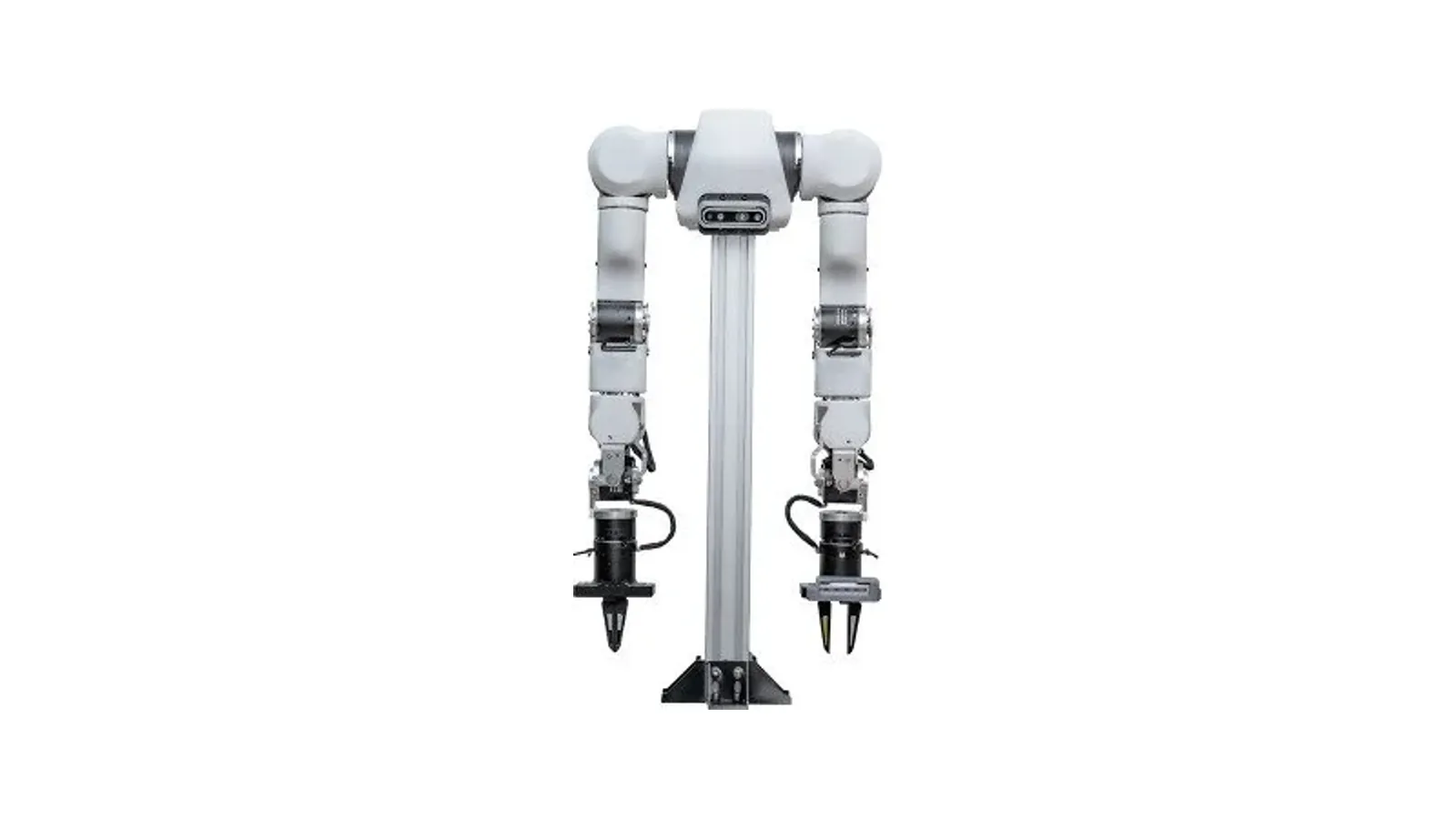
Imitation learning has become the dominant approach for teaching robots real-world manipulation tasks. Instead of hand-coding behaviors or running millions of simulation trials, you demonstrate the task and the robot learns to replicate it. But the robot arm you choose determines everything: data quality, collection speed, policy compatibility, and whether your trained models actually transfer to deployment. This guide compares six robots for imitation learning and AI training in 2026, covering price, ecosystem, data collection workflow, and policy framework compatibility.
What Makes a Robot Good for Imitation Learning?
Not every robot arm is equally suited for imitation learning. The key factors, in order of importance:
- Teleoperation quality. The operator must be able to demonstrate tasks naturally and precisely. Leader-follower setups (where you physically guide a matched arm) produce the cleanest data. VR controller teleoperation works but adds latency and a perception gap. Kinesthetic teaching (backdriving the arm directly) is intuitive but produces noisier trajectories.
- Joint position accuracy and repeatability. The robot must reliably reach the positions recorded during demonstration. Backlash, flex, and calibration drift in cheap servos produce noisy data that requires more demonstrations to overcome.
- Policy framework compatibility. The robot should work with major frameworks -- LeRobot, ACT, Diffusion Policy, VLA models -- without extensive custom integration. Native support means you can go from data collection to trained policy in hours, not weeks.
- Camera mounting. Imitation learning policies typically require wrist-mounted and third-person cameras. The arm must have standard mounting points and enough payload capacity for cameras without degrading performance.
- Community and support. An active community means published task configurations, pretrained checkpoints, debugging resources, and hardware modifications that accelerate your work.
The Robots
AgileX Piper -- Budget Research
AgileX Piper is a 6-DOF lightweight arm designed for education and research at a fraction of the cost of Franka or UR. It uses Dynamixel servos and includes a teacher pendant for leader-follower data collection.
Why it fits: The Piper (current store price: $3,500.00) is a low-cost manufactured arm that still produces research-quality demonstration data. It has ROS2 support, a growing LeRobot community, and enough repeatability for tabletop manipulation tasks. For labs on a tight budget that need something more capable than a DIY build, the Piper hits a practical sweet spot.
Specs: 6 DOF, 1.5 kg payload, 300 mm reach, Dynamixel XM series servos, parallel jaw gripper included, teacher pendant for leader-follower teleoperation.
Best for: Education, university courses, initial prototyping, tasks where budget is the primary constraint and the workspace is small.
Limitations: Shorter reach (300mm) limits workspace size. Dynamixel XM servos have more backlash than the XH or DM-J series used in higher-end arms. The teacher pendant is lighter than the actual arm, creating a kinematic feel mismatch during teleoperation. Smaller community and fewer published baselines than OpenArm or ALOHA.
Data collection throughput: 40-60 demonstrations per hour for simple tasks. The shorter reach means less operator fatigue but also constrains task design.
Mobile ALOHA -- Best for Bimanual Tasks
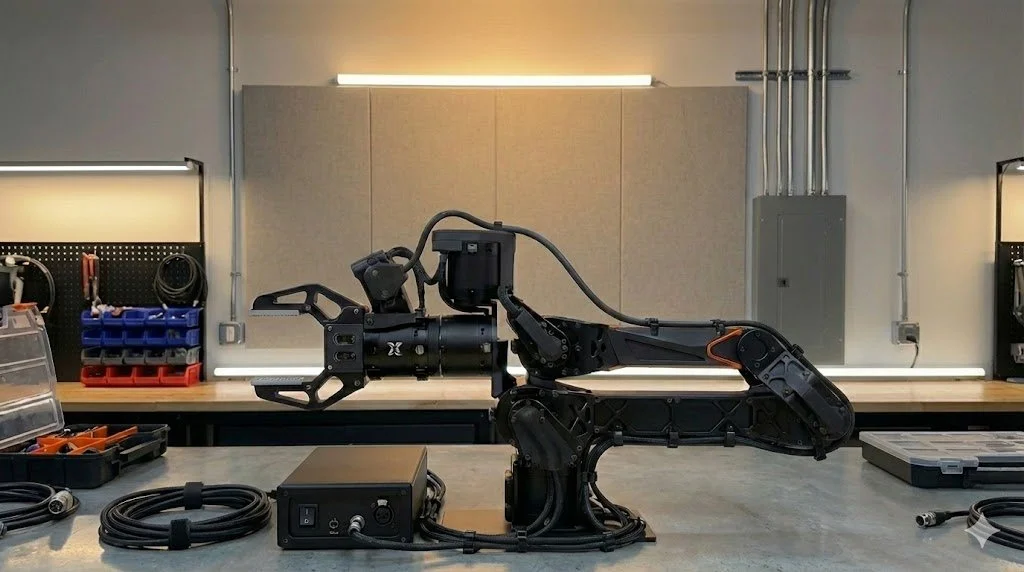
Mobile ALOHA combines two ViperX 300 6-DOF arms on a mobile base with leader-follower teleoperation for both arms simultaneously. It was developed at Stanford and is the hardware platform where ACT (Action Chunking with Transformers) was originally demonstrated.
Why it fits: Mobile ALOHA is a platform purpose-built for bimanual imitation learning. Two-arm coordination is essential for tasks like folding laundry, opening containers while pouring, or any task requiring one hand to stabilize while the other manipulates. The ACT framework was designed and validated on this exact hardware, meaning you get the most direct reproduction path for state-of-the-art bimanual policies.
Specs: 2x ViperX 300 arms (6 DOF each), Dynamixel servos, parallel jaw grippers, mobile base with 2 m/s max speed. Total 14 DOF (6+1 per arm). Leader arms included for bilateral teleoperation.
Best for: Bimanual manipulation, mobile manipulation, kitchen tasks, laundry folding, object handoffs. Any task that fundamentally requires two arms or arm-plus-base coordination.
Limitations: Dynamixel servos have more backlash than the DM-J actuators in OpenArm, producing slightly noisier joint data. The mobile base adds complexity to both data collection (the operator must coordinate two arms plus locomotion) and policy training (larger action space). Payload per arm is limited to 750g.
Data collection throughput: 20-40 bimanual demonstrations per hour depending on task complexity. The dual-arm teleoperation requires practice -- expect 2-4 hours of operator training before reaching peak efficiency.
OpenArm -- Best for LeRobot Workflows
Top Pick
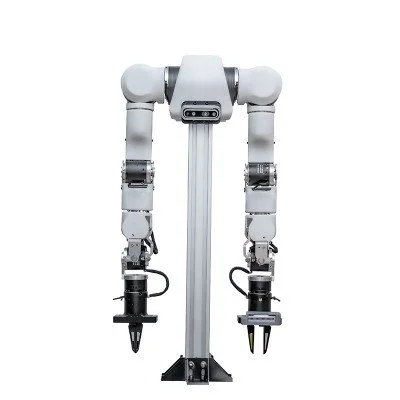
OpenArm is our recommendation for imitation learning in 2026. Native LeRobot integration, leader-follower teleoperation out of the box, and the best data quality per dollar (current store price: $5,400.00).
OpenArm is a 6-DOF robot arm designed from the ground up for imitation learning. It ships as a leader-follower pair: one arm for demonstration, one for autonomous execution. The joint modules use DM-J4310 actuators with high-resolution encoders, providing smooth backdriving and accurate position recording without the backlash problems that plague servo-based arms.
Why it fits: OpenArm has native LeRobot integration. You can record demonstrations, train ACT or Diffusion Policy models, and deploy them back to the arm using a single framework with minimal configuration. The leader-follower setup produces high-quality demonstration data because the operator directly feels the forces and contacts during the task, leading to more natural and consistent demonstrations.
Specs: 6 DOF, 1.5 kg payload, 550 mm reach, position repeatability +/-0.1mm, parallel jaw gripper included (Dynamixel XL330-based). The leader arm mirrors the follower arm exactly, so there is no kinematic mismatch between demonstration and execution.
Best for: Tabletop manipulation, pick-and-place, stacking, pouring, insertion tasks. Single-arm tasks where data quality and framework compatibility matter more than workspace size or payload.
Limitations: Single-arm only (no bimanual without buying two pairs). 1.5 kg payload limits heavy-object tasks. Smaller community than ALOHA, though growing rapidly.
Data collection throughput: Expect 60-80 demonstrations per hour for simple pick-and-place tasks, 30-40 per hour for multi-step tasks. The leader-follower setup has essentially zero setup time between episodes.
SO-101 -- Cheapest Entry Point
SO-101 (SO-ARM100 successor) is a fully open-source 6-DOF robot arm that can be 3D-printed and assembled for around $300 in parts. It uses budget Dynamixel or STS3215 servos and is designed as the absolute minimum viable platform for learning imitation learning.
Why it fits: The SO-101 is the only way to start doing imitation learning for under $500. LeRobot officially supports it, and there are published ACT configurations that work on this hardware. It is the ideal first arm for students, hobbyists, and researchers who want to understand the full pipeline before investing in more expensive hardware.
Specs: 6 DOF, 250g payload, ~250mm reach, STS3215 or Dynamixel XL330 servos, 3D-printed links. Leader arm can be built from the same parts for under $300 total for the pair.
Best for: Learning the imitation learning pipeline, student projects, teaching, proof-of-concept experiments, extremely budget-constrained research.
Limitations: Significant backlash and flex in 3D-printed joints produce noisy data. Low payload means only very light objects (utensils, small blocks, paper). The arm is not rigid enough for tasks requiring precision. Expect to need 2-3x more demonstrations than OpenArm for the same task due to data noise. Not suitable for publication-quality results without significant data curation.
Data collection throughput: 50-80 demonstrations per hour for simple tasks (the arm moves quickly due to low mass). However, data quality per demonstration is lower, so effective throughput is reduced when accounting for curation.
Universal Robots UR5e -- Industrial Grade
UR5e is the most deployed collaborative robot arm in the world. While designed for industrial automation, it has strong imitation learning credentials: ROS2 support, freedrive mode for kinesthetic teaching, and a proven track record in both research and production environments.
Why it fits: The UR5e bridges research and deployment. Policies trained on a UR5e in the lab can deploy directly to UR5e arms in production facilities without hardware changes. The built-in force/torque sensor, 5 kg payload, and 850 mm reach handle a wider range of real-world tasks than lighter research arms. If your goal is to train policies that ship to customers running UR arms, the UR5e is the obvious choice.
Specs: 6 DOF, 5 kg payload, 850 mm reach, repeatability +/-0.03mm, built-in 6-axis F/T sensor, freedrive mode for kinesthetic teaching.
Best for: Industrial manipulation tasks, bin picking, machine tending, assembly, any application where the trained policy will deploy on UR hardware in production.
Limitations: No leader-follower setup available out of the box -- teleoperation requires freedrive mode (kinesthetic teaching) or external input devices. The UR controller runs a 500Hz servo loop but the external control interface (RTDE) is limited to 125Hz for commanded positions, which is adequate for most imitation learning but limits high-frequency reactive behaviors.
Data collection throughput: 25-45 demonstrations per hour with kinesthetic teaching, 30-50 with VR teleoperation. Freedrive mode is intuitive but can be tiring for the operator over long sessions due to the arm's 20 kg weight.
Comparison Table
| Robot | Price | DOF | Payload | Reach | Teleop Method | LeRobot | ACT |
|---|---|---|---|---|---|---|---|
| AgileX Piper | $3,500.00 | 6 | 1.5 kg | 300 mm | Teacher pendant | Community | Experimental |
| Mobile ALOHA | $20,000.00 | 2x6+2 | 750g/arm | 450 mm | Bilateral leader-follower | Yes | Native |
| OpenArm | $5,400.00 | 6 | 1.5 kg | 550 mm | Leader-follower | Native | Yes |
| SO-101 | $500.00 | 6 | 250g | ~250 mm | Leader-follower (DIY) | Native | Yes |
| UR5e | Request a Quote | 6 | 5 kg | 850 mm | Freedrive / VR | Community | Yes |
Data Collection Tools: Beyond the Arm
The robot arm is only half the data collection equation. The demonstration interface -- how the operator records trajectories and sensory observations -- determines data quality as much as the arm itself. RCSV offers three purpose-built data collection tools that work across all the arms listed above.
RCSV UMI (Universal Manipulation Interface)
The RCSV UMI is a handheld data collection device that captures gripper-centric manipulation demonstrations without requiring a robot arm at all. The operator holds the UMI like a tool, performs the task in a natural environment, and the device records 6-DOF pose trajectories and wrist camera images. UMI demonstrations can then be retargeted to any robot arm for policy training. This decouples data collection from the robot, enabling massively parallel data collection across many operators and environments.
RCSV Dex-UMI
The Dex-UMI extends the UMI concept to dexterous manipulation. Instead of a parallel jaw gripper, Dex-UMI captures multi-finger demonstrations using an instrumented glove. It records individual finger positions, contact forces, and wrist pose simultaneously. Dex-UMI data trains dexterous manipulation policies for robot hands like the LEAP Hand or Allegro Hand.
RC G1 Tactile Glove
The RC G1 Tactile Glove is a high-resolution tactile sensing glove that captures finger joint angles and fingertip contact forces during human demonstrations. Unlike Dex-UMI (which captures external pose), the RC G1 focuses on proprioceptive and tactile signals -- what the fingers feel, not just where they are. Combined with external camera observations, RC G1 data enables training policies that react to contact forces, a capability critical for fragile object handling and fine assembly.
Policy Frameworks: What Works on What
The choice of policy learning framework interacts with your hardware. Here is what works best on each platform:
- ACT (Action Chunking with Transformers): Best on Mobile ALOHA (native), works well on OpenArm, Franka, UR5e. ACT predicts chunks of future actions (typically 50-100 timesteps) from visual observations, making it robust to small timing errors in demonstrations. The best all-around choice for manipulation tasks.
- Diffusion Policy: Works across all platforms. Generates actions by iteratively denoising from random noise, producing smooth and multimodal trajectories. Particularly strong for tasks with multiple valid solutions (e.g., placing objects in any of several valid locations). Requires slightly more compute than ACT but handles ambiguous tasks better.
- VLA (Vision-Language-Action) models: Platform-agnostic -- VLA models like RT-2 and Octo take language instructions and images as input. They require more demonstrations (500+) but generalize across tasks and objects. Best suited to labs with large-scale data collection capacity, ideally using UMI for parallel data collection.
- LeRobot: The LeRobot framework from Hugging Face provides a unified interface for data recording, model training, and deployment. It natively supports OpenArm, Mobile ALOHA, and SO-101, with community drivers for other platforms. LeRobot is the fastest path from zero to a working policy.
Platform Integration: Fearless Data Platform
Managing demonstration data at scale -- versioning, quality filtering, augmentation, and training orchestration -- requires purpose-built infrastructure. The Fearless Data Platform provides:
- Dataset management: Upload, version, and browse demonstration datasets. Automatic metadata extraction (joint positions, camera frames, episode boundaries, task labels).
- Quality scoring: Automated scoring of demonstration quality based on trajectory smoothness, task completion, and consistency metrics. Filter out failed or low-quality demonstrations before training.
- Training orchestration: Launch ACT, Diffusion Policy, or custom training jobs with one click. Track experiments, compare checkpoints, and deploy the best model back to the robot.
- Multi-robot support: Manage data from heterogeneous robot fleets. Retarget demonstrations collected on one arm type to train policies for another (e.g., UMI data to OpenArm policy).
Which Robot Should You Buy?
Use this decision framework:
- Smallest budget, learning the pipeline: SO-101. Build it yourself, run LeRobot tutorials, train your first ACT policy. Graduate to better hardware once you understand the workflow.
- Serious single-arm research on a modest budget: OpenArm (current store price: $5,400.00). Best data quality per dollar, native LeRobot support, active community. This is the default recommendation for most researchers starting imitation learning work.
- Need bimanual manipulation: Mobile ALOHA (current store price: $20,000.00). A bimanual platform with proven ACT policies.
- Deploying to production on UR hardware: UR5e (current store price: Request a Quote). Train and deploy on the same platform. The force/torque sensor and 5 kg payload handle real-world tasks.
- Education, classroom, tight budget: AgileX Piper (current store price: $3,500.00). Adequate quality for teaching and prototyping at a low cost for a manufactured arm.
Frequently Asked Questions
What is the best robot for imitation learning in 2026?
The OpenArm (current store price: $5,400.00) is the best value robot for imitation learning in 2026. It has native LeRobot integration, 6-DOF leader-follower teleoperation out of the box, and a growing open-source community. For bimanual tasks, Mobile ALOHA (current store price: $20,000.00) is the top choice.
What is the best robot arm for ACT training?
For ACT (Action Chunking with Transformers) training, the best options are Mobile ALOHA for bimanual ACT policies, OpenArm for single-arm ACT with LeRobot, and the SO-101 for budget ACT experiments. ACT was originally developed on ALOHA hardware, so Mobile ALOHA provides the most direct reproduction path.
How much does a robot for imitation learning cost?
Robots suitable for imitation learning range from a $300 SO-101 DIY kit up to research-grade 7-DOF arms. The best value is the OpenArm (current store price: $5,400.00), which includes leader-follower arms, gripper, and LeRobot compatibility. Mobile ALOHA (current store price: $20,000.00) offers bimanual capability. Budget builds using the SO-101 can start under $500.
What is the difference between imitation learning and reinforcement learning for robots?
Imitation learning trains robot policies from human demonstrations -- the operator shows the robot how to perform a task, and the robot learns to replicate the behavior. Reinforcement learning trains through trial-and-error with a reward signal. Imitation learning is faster to get working (50-200 demonstrations vs. millions of RL steps), more sample-efficient, and does not require designing a reward function, which is why most practical robot learning systems in 2026 use imitation learning.
How many demonstrations do I need for imitation learning?
For simple tasks like pick-and-place, 50-100 high-quality demonstrations are typically sufficient with ACT or Diffusion Policy. For complex multi-step tasks, expect 200-500 demonstrations. Data quality matters more than quantity: consistent demonstrations with low variance produce better policies than large noisy datasets. The Fearless Data Platform helps manage and curate demonstration datasets.
Can I use imitation learning with a budget robot arm?
Yes. The SO-101 (current store price: $500.00) and AgileX Piper (current store price: $3,500.00) both support imitation learning workflows. The SO-101 works with LeRobot and can train ACT policies, though its lower build quality means noisier data and longer training times. For serious research, the OpenArm (current store price: $5,400.00) provides substantially better data quality at a moderate price increase.
Related: ALOHA vs UMI Data Collection · LeRobot Getting Started · ACT Policy Explained · Common Mistakes in Imitation Learning · RCSV Store