






What Is a Humanoid Robot?
What is a humanoid robot? Comprehensive guide covering definition, history from ASIMO to Atlas, current platforms (Unitree G1, Figure 02, Booster K1), how they learn, applications, and how to buy one in 2026.
The complete guide to humanoid robots in 2026: how they work, what they cost, and why they are entering warehouses, factories, and homes faster than anyone predicted.
What Is a Humanoid Robot?
A humanoid robot is a robot whose body plan is designed to resemble the human form. At minimum it has a torso, a head, and two arms. Most humanoid robots also feature two legs capable of bipedal locomotion, although some use wheeled bases for practical deployment. The defining feature is anthropomorphism—the robot is shaped like a person so it can operate in environments built for people: doorways, staircases, workstations, vehicles, and homes.
Key characteristics that define a humanoid robot:
- Bipedal or upright posture — Standing 1.2–1.8 m tall, roughly matching the human envelope so it fits through standard doors and reaches standard shelves.
- Anthropomorphic upper body — Two arms with multi-fingered or gripper-style hands capable of grasping, carrying, and tool use.
- High degrees of freedom (DOF) — Typically 23–50+ DOF across all joints, enabling natural movement. Each DOF corresponds to an independent axis of rotation or translation in a joint.
- Sensor suite — Cameras (stereo or RGB-D), IMUs, force/torque sensors, and sometimes LIDAR or tactile skin, giving the robot perception of itself and its surroundings.
- Onboard compute — Modern humanoids run neural network policies on embedded GPUs (e.g., NVIDIA Jetson Orin), processing vision and control at 30–500 Hz.
Humanoid robots are distinct from industrial robot arms (single manipulators bolted to a table), autonomous mobile robots (AMRs) (wheeled platforms focused on navigation), and quadrupeds (four-legged robots like Boston Dynamics Spot). The human form factor is specifically chosen when the task requires operating in unmodified human spaces or when human-robot interaction demands an intuitive, relatable presence.
A Brief History of Humanoid Robots
The dream of building a machine in our own image stretches back centuries, but practical humanoid robotics is a story of the last three decades. Here are the milestones that matter:
1996 — Honda P2
The first truly self-contained bipedal humanoid robot capable of autonomous walking. Weighed 210 kg and stood 1.82 m tall. Proved that dynamic bipedal locomotion was mechanically achievable.
2000 — Honda ASIMO
The world's most famous humanoid. ASIMO could walk, run (6 km/h), climb stairs, recognize faces, and respond to voice commands. Through multiple iterations until 2018, ASIMO shaped public perception of what a robot could be.
2004 — HRP-2 (AIST, Japan)
A research-grade humanoid that became a standard platform for academic bipedal locomotion and whole-body control research. Influenced a generation of robotics PhDs.
2013 — Boston Dynamics Atlas (hydraulic)
Built for the DARPA Robotics Challenge. Atlas demonstrated unprecedented dynamic agility: walking over rubble, opening doors, and recovering from pushes. Its parkour videos later went viral.
2017 — SoftBank NAO & Pepper
Small-form-factor humanoids focused on social interaction rather than physical labor. Deployed in retail, hospitality, and education, demonstrating commercial demand for human-shaped robots.
2022 — Tesla Optimus announcement
Elon Musk unveiled the Optimus prototype at Tesla AI Day, signaling automotive-scale manufacturing ambitions for humanoid robots. Targeted eventual pricing under $20,000.
2023 — The Cambrian Explosion
Dozens of humanoid startups emerged: Figure AI, Apptronik, 1X Technologies, Fourier Intelligence, Unitree, and others. Combined private funding exceeded $5 billion. The convergence of cheap actuators, powerful GPUs, and foundation models for robotics made humanoids suddenly viable.
2024 — Boston Dynamics Atlas goes electric
Boston Dynamics retired the hydraulic Atlas and revealed an all-electric version designed for commercial deployment in partnership with Hyundai. Simultaneously, Figure 02 began pilot deployments at BMW factories.
2025–2026 — Commercial shipping begins
Unitree G1 and H1, Fourier GR-1, and Booster K1 became available for commercial purchase. The era of the humanoid robot as a product—not just a research project—officially arrived.
Current Humanoid Robots You Can Buy or Deploy
7 humanoid platforms shipping in 2026 — Commercial humanoid robots are no longer vaporware. From $21,500 compact research units to $150K+ enterprise systems, the market has arrived.
The humanoid market has rapidly matured. Below are the leading platforms available in 2026, ranging from compact research units to full-size industrial models.

Unitree G1
From $21,500
Compact humanoid (127 cm, 35 kg) with 23–43 DOF depending on configuration. Features dexterous hands and force-feedback joints. Ideal for research, education, and light manipulation tasks. One of the most affordable humanoids on the market.
Unitree H1
Contact for pricing
Full-size humanoid (180 cm, 47 kg) capable of running at 3.3 m/s, making it one of the fastest bipedal robots. 26 DOF with powerful M107 joint motors. Designed for logistics, inspection, and dynamic locomotion research.
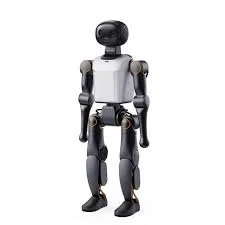
Booster K1
From $16,000
Mid-tier humanoid between compact research platforms (Unitree G1) and full-size industrial humanoids. 170 cm frame with high-torque actuators, modular tool interface on each arm, and IP54-rated enclosure. Popular for warehouse and manufacturing research pilots.
Figure 02
Enterprise only
Figure AI's second-generation humanoid, deployed in pilot programs at BMW and other manufacturers. Features advanced dexterous manipulation, conversational AI powered by large language models, and a 5-hour battery. Not yet available for individual purchase.
Fourier GR-1
Contact for pricing
A 55 kg, 165 cm humanoid with 44 DOF and FSA (Fourier Smart Actuator) series motors. Designed as an open research platform with ROS 2 integration and extensive SDK. Strong adoption in university labs and rehabilitation research.
Tesla Optimus (Gen 2)
Not yet commercially available
Tesla's humanoid targets high-volume manufacturing economics: 28 DOF, 11-DOF hands, and an automotive-grade sensor suite. Internal deployment at Tesla factories is underway, with broader commercial availability expected by late 2026–2027.
Boston Dynamics Atlas (Electric)
Not commercially available
The latest Atlas is fully electric, lighter, and more agile than the hydraulic predecessor. Features exceptional dynamic balance and manipulation. Currently deployed in limited partnerships with Hyundai for automotive manufacturing pilots.
Humanoid Robot Specs at a Glance
| Platform | Price | Height | DOF | Available |
|---|---|---|---|---|
| Unitree G1 | from $21,500 | 127 cm | 23–43 | Yes |
| Unitree H1 | ~$90,000 | 180 cm | 26 | Yes |
| Booster K1 | from $16,000 | 170 cm | 30+ | Yes |
| Fourier GR-1 | Contact | 165 cm | 44 | Yes |
| Figure 02 | $50–150K est. | 170 cm | 16+ | Pilot only |
| Tesla Optimus | TBD | 173 cm | 28+ | No |
| BD Atlas (Elec.) | N/A | ~150 cm | 28+ | No |
Browse All Humanoid Robots
Compare specs, pricing, and availability across every humanoid platform we carry.
How Humanoid Robots Learn New Tasks
The hardware is only half the story. What makes 2026-era humanoids genuinely useful is a revolution in how they acquire skills. Instead of painstakingly hand-coding every motion trajectory, modern humanoids learn from data.
Imitation Learning (Learning from Demonstration)
A human operator demonstrates a task—folding laundry, placing a box on a shelf, inserting a connector—while the robot records joint angles, camera images, and force readings. The robot then trains a behavior cloning policy: a neural network that maps observations to actions. With enough demonstrations (often 50–200 for a single task), the robot generalizes to handle variations it has never seen.
Teleoperation hardware such as bimanual leader-follower rigs, VR controllers, and motion-capture gloves make it practical to collect demonstrations at scale. RCSV data services offers turnkey demonstration data collection for teams that need large, high-quality training sets.
Vision-Language-Action (VLA) Models
The most significant AI advancement for humanoid robots is the VLA model: a single foundation model that takes camera images and a natural-language instruction ("pick up the red cup and place it on the tray") and outputs motor commands. VLAs like RT-2, Octo, and OpenVLA combine the world knowledge of large language models with visuomotor control, enabling robots to follow novel instructions and generalize across environments.
RCSV's platform provides model training infrastructure and pre-trained VLA checkpoints optimized for humanoid embodiments.
Key Insight: VLA models can generalize across tasks with zero additional training. A single model trained on diverse manipulation data can follow novel instructions it has never seen before, dramatically reducing deployment time.
Sim-to-Real Transfer
Training directly on physical robots is slow and expensive. Sim-to-real pipelines train policies in physics simulators (Isaac Sim, MuJoCo, Genesis) where the robot can run millions of episodes in hours, then transfer the learned policy to real hardware. Domain randomization—varying textures, lighting, physics parameters—bridges the gap between simulated and real environments.
For bipedal locomotion in particular, sim-to-real reinforcement learning has proven remarkably effective. The Unitree G1's walking and stair-climbing policies are trained almost entirely in simulation.
Reinforcement Learning (RL)
RL algorithms let robots discover behaviors through trial and error, guided by reward signals. In simulation, an RL agent can attempt a task millions of times, gradually improving its policy. RL is especially powerful for locomotion, balance recovery, and dynamic manipulation tasks where optimal behavior is hard to demonstrate.
Train Your Humanoid
Use RCSV's platform to collect demonstrations, train VLA models, and deploy policies to humanoid hardware.
Explore the Platform Data Collection Services
Applications: Where Humanoid Robots Work Today
Humanoid robots are no longer confined to labs. Here are the sectors where they are creating real value in 2026:
Warehouse & Logistics
The largest deployment opportunity. Humanoids pick, pack, and palletize in existing warehouses without requiring infrastructure changes like conveyor systems or goods-to-person shuttles. They navigate aisles, reach high shelves, and handle heterogeneous SKUs—tasks where fixed automation fails. BMW, Amazon, and GXO are running active pilots.
Manufacturing & Assembly
Humanoids perform final assembly tasks alongside human workers: inserting cables, tightening fasteners, quality inspection, and material transport between stations. Their human form factor means they can use the same workstations, jigs, and tools. Automotive and electronics factories are early adopters.
Healthcare & Eldercare
Assistive humanoids help patients with mobility, deliver medication, and provide social interaction for elderly residents. Japan leads in this domain, driven by an aging population and labor shortage. Toyota's Human Support Robot and emerging humanoid platforms serve rehabilitation and daily living assistance.
Hospitality & Service
Hotels, restaurants, and retail stores deploy humanoids as concierges, guides, and delivery agents. The human form creates natural interaction—guests instinctively understand how to communicate with a human-shaped robot. SoftBank's Pepper pioneered this segment; next-generation platforms add physical capabilities like carrying luggage and cleaning.
Hazardous Environments
Nuclear decommissioning, disaster response, offshore energy, and underground mining all involve environments too dangerous for sustained human presence but designed for the human body. Humanoids can enter these spaces and use human tools—door handles, valves, ladders—without custom infrastructure.
Research & Education
Universities and research labs use humanoid platforms to advance locomotion, manipulation, and AI research. Open-source-friendly platforms like the Fourier GR-1 and Unitree G1 serve as standardized testbeds. The lower price point (from $16K) has made full-size humanoids accessible to labs that previously could only simulate them.
How to Buy a Humanoid Robot: Pricing & Options
The commercial humanoid market is young but rapidly standardizing. Here is what you need to know before purchasing:
Price Ranges
- $21,500–$73,900 — Compact humanoids (120–140 cm) like the Unitree G1 (Basic $21,500, Edu Standard $43,900, Edu Pro $56,900, Edu Ultimate $73,900). Best for research, education, and controlled environments. Typically ship within 4–8 weeks.
- $16,000–$50,000 — Mid-tier humanoids like the Booster K1 (from $16,000) and Fourier GR-1. 170 cm frames, high-torque actuators, and modular tooling. Suitable for research, education, and warehouse/manufacturing pilots.
- $80,000–$250,000+ — Enterprise-grade full-size humanoids like Apptronik Apollo, Figure 02, and 1X NEO. Advanced dexterous manipulation, integrated AI stacks, and deployment support.
Leasing
Not ready to buy? Leasing lets you deploy a humanoid robot with lower upfront commitment. Lease terms typically start at $2,000–$5,000/month and include maintenance and software updates. This is ideal for pilot programs, seasonal demand, and organizations evaluating the technology.
What to Consider
- DOF and dexterity — More degrees of freedom enable more complex tasks but increase cost and software complexity.
- Payload capacity — How much weight each arm can carry. Ranges from 3 kg (Unitree G1) to 10+ kg (Booster K1).
- Battery life — Most humanoids run 2–5 hours per charge. Consider whether hot-swappable batteries are available.
- Software ecosystem — ROS 2 support, Python/C++ SDKs, and available pre-trained models dramatically affect time-to-deployment.
- Sim environment — Does the manufacturer provide a digital twin in Isaac Sim, MuJoCo, or Gazebo? Essential for safe policy development.
- Support and warranty — On-site support, spare parts availability, and warranty terms vary significantly between manufacturers.
Where to Buy
RCSV is an authorized distributor for Unitree, Booster, Fourier, and other leading humanoid brands. We offer:
- Direct purchase and leasing
- Pre-delivery configuration and testing
- Onboarding and integration support
- Training data collection and AI policy development via our platform and data services
Ready to Get Started?
Whether you are buying your first research humanoid or deploying a fleet in a warehouse, we can help.
Shop Humanoid Robots Lease a Robot Data Services
Frequently Asked Questions
What is a humanoid robot?
A humanoid robot is a robot designed to resemble the human body in form and movement. It typically features a head, torso, two arms, and two legs, enabling bipedal locomotion and manipulation of objects in environments built for people.
How much does a humanoid robot cost?
Commercial humanoid robots range from approximately $21,500 for the entry-level Unitree G1 Basic to $150,000 or more for full-size research and industrial models. Leasing options are available starting from $6,000 per month for the Unitree G1. Browse current pricing →
What are humanoid robots used for?
Humanoid robots are used in warehouse logistics, manufacturing assembly, healthcare assistance, hospitality and service roles, research and education, and hazardous environment inspection. Their human-like form allows them to operate in spaces designed for people without infrastructure modifications.
Can I buy a humanoid robot today?
Yes. Several commercial humanoid robots are available for purchase in 2026, including the Unitree G1, Unitree H1, Booster K1, Figure 02 (enterprise), and Fourier GR-1. These can be ordered through RCSV.
How do humanoid robots learn new tasks?
Modern humanoid robots learn through imitation learning (watching human demonstrations), reinforcement learning (trial-and-error in simulation), and vision-language-action (VLA) models that combine natural language understanding with physical actions. Sim-to-real transfer allows policies trained in simulation to be deployed on real hardware. Learn more about robot training →
What is the difference between a humanoid robot and an android?
A humanoid robot has a human-like body plan (head, torso, arms, legs) but is clearly a machine. An android is a subset of humanoid robots designed to closely mimic human appearance, often with realistic skin, facial expressions, and hair. Most commercial humanoid robots today are functional humanoids rather than androids.
How many degrees of freedom does a typical humanoid robot have?
A typical humanoid robot has between 23 and 50+ degrees of freedom (DOF). For example, the Unitree G1 has 23 to 43 DOF depending on configuration, while the Fourier GR-1 has 44 DOF. More DOF generally means more dexterous and natural movement, but also increases mechanical complexity and cost.
Start Building with Humanoid Robots
From research platforms to enterprise deployments, RCSV provides hardware, software, and expert support for every stage of your humanoid robotics journey.
Shop Humanoid Robots Leasing Options Data Services