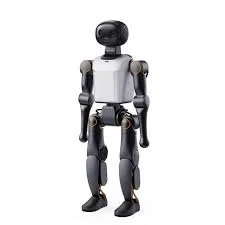
Unitree H1
Full-size humanoids amplify dynamic challenges: impact loads, larger workspaces, and stricter safety planning. Treat H1-level platforms as systems programs — not single-discipline toys.
Learning outcomes
- Relate power, thermal, and sustained load to real demos vs peak stunts.
- Trace perception and planning dependencies for full-body tasks.
- Document operational limits for your space and staffing.
Learn
Full-body system: power, compute, sensing, thermal, safety.
Practice
Fill a systems table: subsystem, owner, failure mode, fallback.
Challenge
Run a tabletop “incident” drill; post what you would log on the Forum.
Facilitation: Emphasize team roles — no single student “owns” the whole humanoid safely.
Self-check
What fails first under sustained load?
Often thermal or battery — measure before chasing policy quality.
When is a smaller platform enough?
When tasks fit a fixed arm or quadruped + arm — see Humanoids trade space.
STEM alignment: energy & systems, engineering reliability, teamwork under uncertainty.
Systems checklist
- Power & thermal: sustained walking and manipulation vs peak demos.
- Fall policy: what should controllers do near instability?
- Logging: high-rate state for debugging — ties to Data Platform thinking.
- Human proximity: barriers, procedures, and training.
H1 vs G1 — how to choose pedagogically?
If the goal is approachable whole-body research in tighter spaces, G1 may fit more cohorts. H1 shines when you must stress-test algorithms at larger scale — with matching safety and staffing.
Link to Physical AI content
Explore Humanoid Intelligence Hub for models, datasets, and narratives that pair with hardware chapters.