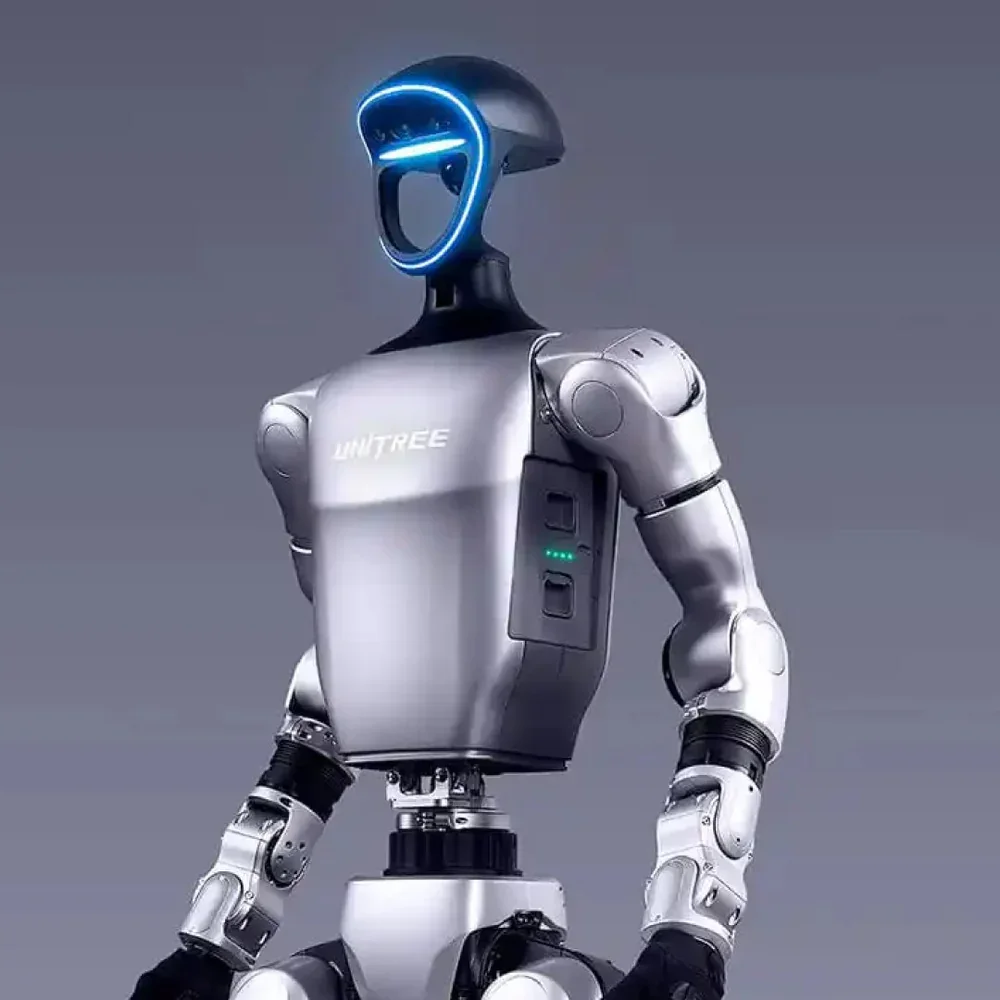
Unitree G1
The G1 family targets a sweet spot for labs and developers: a compact humanoid form factor for whole-body motion and manipulation research — with the engineering discipline that bipeds demand (power, balance, fall recovery, and operational safety).
Learning outcomes
- Explain static stability and contact before flashy motion.
- Relate humanoid subsystems (locomotion, perception, balance) to your scope.
- Identify safety and operator training gaps for your environment.
Learn
Support polygons, stepping, perception stack at a high level.
Practice
Watch logs or sim: note when balance vs task planning dominates.
Challenge
Define a single measurable skill for your cohort; discuss on the Forum.
Facilitation: Cap scope — one of {balance, gait, manipulation}; never all three week one.
Self-check
Why start with statics?
Falls and contact errors dominate before “smart” policies matter.
Where does SVRC defer to vendors?
Firmware, safety certifications, and field service — confirm on Store and docs.
STEM alignment: mechanics & motion, systems integration, safety-informed engineering.
How to study G1 methodically
- Statics & support: understand contact patches and center of pressure before flashy motions.
- Arm stack: pair with glove teleop or bench arms first, then mount skills on the full body.
- Software: sim alignment, logging, and reproducible episode structure — same themes as Communication & architecture.
- Safety: harnesses, zones, trained spotters — non-negotiable for humanoids around people.
G1 vs quadruped (e.g. Go2)
Quadrupeds excel at locomotion over varied terrain with simpler stability in many regimes. Bipeds trade that for manipulation height and anthropomorphic task structure — often harder overall. See Go2 showcase for quadruped context.
Where to buy or try hardware?
Check current listings on the SVRC store and talk to the team for same-day pickup or special orders in Palo Alto.
Compare: Unitree H1 chapter for the larger humanoid envelope — different dynamics and operational footprint.