← Robotics Academy · OpenArm hub
Chapter 2OpenArm platform
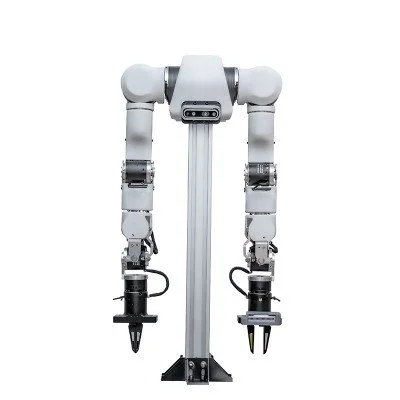
OpenArm is built for contact-rich manipulation and learning-ready data: reproducible hardware, clear interfaces, and tight integration with modern robot-learning stacks.
Learning outcomes
- Contrast teaching arms with a logging-first manipulation platform.
- Describe CAN setup concerns (termination, IDs) that affect dataset validity.
- Plan calibration and tool-change checks before policy experiments.
Data loop, drives, calibration, and SVRC ops context.
Sketch left/right URDF mapping; list one episode field you will log.
Outline a minimal eval harness; ask for feedback on the Forum.
Self-check
When move from SO-101 to OpenArm?
What must stay consistent across arms?
STEM alignment: systems integration, testable interfaces, responsible iteration on hardware.
1. Why a separate “platform” chapter
OpenArm sits at the intersection of how SVRC thinks about the data loop and real hardware you can source in Palo Alto. Unlike small teaching arms, the emphasis is on sustained logging, calibration stability, and throughput suitable for imitation learning and evaluation.
2. CAN, drives, and left/right arms
Production arms typically expose multi-axis drives over CAN. You will configure the interface (bitrate, termination), assign controller IDs, and map left/right arms consistently to your URDF or MJCF so policies and datasets stay unambiguous.
3. Calibration & tool changes
Run vendor calibration after mechanical changes. If you swap end-effectors or add mass, update payload estimates or conservatively reduce speed/acceleration until re-identified.
4. Software ecosystem
Teams often bridge OpenArm to recording tools (e.g. LeRobot-style datasets), ROS 2 for integration, or HTTP/WebSocket bridges for quick UI prototypes — see Communication & architecture. Pair with what makes data learning-ready when designing episodes.
5. Operations at SVRC
Same-day pickup on core SKUs, local support, and alignment with our Data Services when you want SVRC to operate collection for you. Specs and pricing are always confirmed on the store and product pages.